Governance is not static. Just as organizational strategy evolves in response to market forces, regulatory shifts, technological disruption, and changing community needs, boards must also evolve. Yet many boards struggle to evolve at the pace their organizations require. Only 35% of executives rate their boards as highly effective, citing concerns about board composition, preparedness for increasing complexity, boardroom engagement, and the need for directors to continually refresh their skills and perspectives (PwC and The Conference Board, 2025). The challenge is no longer simply governance oversight; it is governance adaptation.
This gap between potential and performance has real ramifications. Healthcare today is increasingly complex and turbulent; the stakes are too high and the margin for error too slim for boards to operate on autopilot or rely on outdated approaches. At the same time, healthcare boards have a once-in-a-generation opportunity to transform how we care for patients and support communities while positioning organizations for sustainable futures. Seizing this opportunity requires boards to be prepared for moments of consequence.
Times of inflection or crisis magnify a board's strengths and weaknesses. Through our decades-long work with healthcare boards, we have observed that the most impactful boards treat governance as a long-term investment in organizational capacity. They make deposits of impact through consistent attention to trust, structure, process, composition, and relationships. Compounded over time, these deposits create the reserves boards need to act decisively in defining moments: navigating a crisis, addressing political or financial disruption, executing a bold strategic pivot, or leading a CEO transition. Without these accumulated deposits, boards risk finding themselves overdrawn precisely when their organizations need them most. The best time to build these governance reserves is now — before such consequential moments arrive.
Defining High-Impact Boards
We define a high-impact board as one that is engaged, effective, strategically aligned, and ultimately accelerates organizational success. High-impact governance does not emerge from a single best practice, governance structure, or board composition decision. Rather, it is the result of multiple conditions working together over time to create a board that can provide meaningful oversight, navigate complexity, and guide the organization through periods of both stability and disruption.
Achieving this level of impact requires intentional effort across four dimensions:
- Purpose and priorities: the WHY
- Structure and process: the WHAT
- Composition and succession: the WHO
- Relationships and culture: the HOW
These four conditions are interconnected and mutually reinforcing. Purpose and priorities provide direction. Structure and process create the mechanisms through which governance occurs. Composition and succession ensure the right expertise and leadership are around the table. Relationships and culture determine whether the board can effectively leverage its collective capabilities. Weakness in any one dimension can undermine the effectiveness of the others.
Four Fundamental Conditions of High-Impact Boards
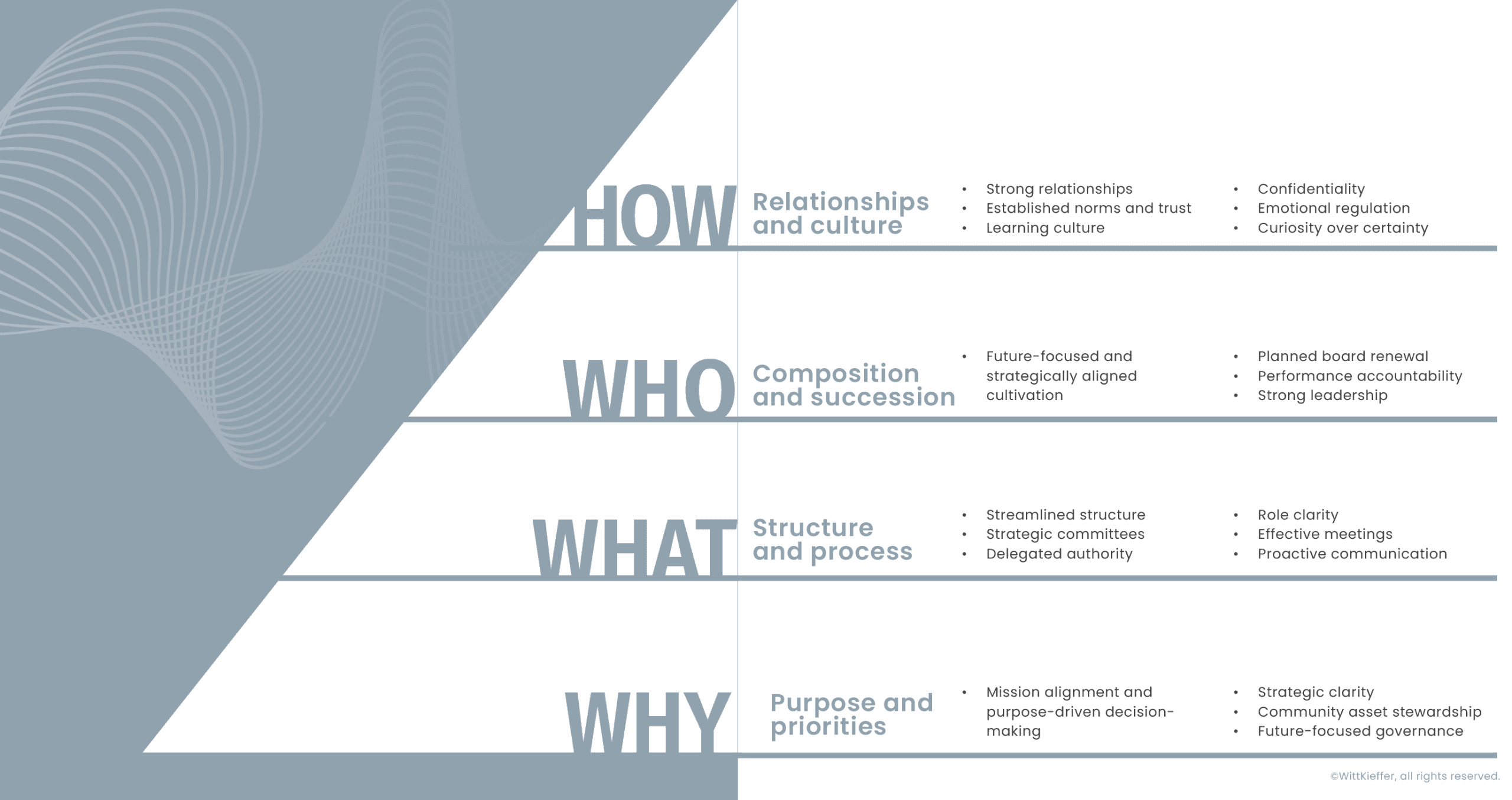
A high-impact board is engaged, effective, strategically aligned, and ultimately accelerates organizational success.
These conditions enable boards to move beyond fiduciary responsibility alone and become strategic assets to the organizations and communities they serve. When boards excel across all four dimensions, they improve decision quality, enhance strategic oversight, and strengthen risk management. More importantly, they build the governance capacity required to act with clarity and confidence when moments of consequence arrive.
WHY: Purpose and Priorities
High-impact boards begin by understanding their WHY, ensuring that the board's purpose and priorities align with the organization's overall mission. This alignment is not a one-time achievement; it requires ongoing reassessment to ensure governance remains relevant, focused, and responsive to changing organizational and community needs.
Strategic clarity
The most effective boards stay focused on their strategic priorities. Board priorities are shifting across industries, with rapid technological advancements (52%) and human capital (42%) now dominating the agenda (Deloitte, 2025). Crisis has become the new reality, and boards are moving from reactive management to proactive strategic positioning. Technology capability and workforce readiness, among other factors, will define organizational success in the years ahead.
However, strategic focus can easily drift into operational detail. When boards spend meeting time debating facility design or patient flow rather than discussing how capital investments support organizational strategy, they fail to advance the organization's mission and long-term objectives. High-impact boards maintain discipline about where they invest their limited time and attention, focusing on strategic implications rather than operational execution. As with many components of high-impact governance, leadership is key here. The board chair plays a pivotal role in maintaining this discipline by setting agendas that privilege strategic issues, time-boxing operational updates, and respectfully redirecting discussion back to mission and strategy when it strays.
Mission alignment and purpose-driven decision-making
Equally important is a shared understanding of mission and vision, taking into account both external and internal realities. High-impact boards regularly revisit their mission, asking whether it remains relevant and whether the organization is delivering on it in ways that reflect changing community needs. This periodic reassessment helps boards avoid defaulting to the status quo and ensures that strategic decisions remain aligned with the organization's core commitments.
Because CEOs and executive teams face intense pressure to deliver near-term results, boards create value by serving as a counterbalance — anchoring discussions in purpose and preserving space for longer-term questions. In doing so, they help ensure that immediate operational demands do not crowd out the organization's broader mission and strategic direction.
High-impact boards maintain discipline about where they invest their limited time and attention, focusing on strategic implications rather than operational execution.
Community asset stewardship
Purpose-driven governance requires boards to balance mission fidelity with financial discipline. Healthcare boards serve as stewards of community assets, responsible for ensuring their organizations remain financially viable while staying true to their missions. When budget pressures threaten mission-critical programs, high-impact boards do not default to immediate closure. Instead, they work with leadership to explore partnerships, alternative funding sources, and innovative redesigns before discontinuing programs that serve their communities.
This balance between purpose and performance is one of the defining characteristics of high-impact governance. Boards that lean too heavily toward either mission or financial metrics risk undermining both over the long term.
Future-focused governance
High-impact boards recognize that governance itself must continuously evolve. Even with strong mission alignment, boards that cling to outdated assumptions, structures, or ways of working will struggle to guide organizations through today's increasingly complex environment. Future-focused governance means regularly asking whether the board's own capabilities, priorities, and governance practices are optimized. It requires boards to anticipate change, not merely react to it. By continually evolving alongside the organizations they serve, boards position themselves to support resilience, adaptability, and long-term success.
In many ways, this commitment to continual renewal is what distinguishes a high-impact board from a functional one. It ensures that purpose remains relevant, priorities remain aligned, and governance remains a strategic asset rather than a compliance exercise.
Purpose and priorities provide the compass for high-impact governance, helping boards navigate complexity, maintain strategic discipline, and make decisions that advance both mission and long-term organizational success. When boards are clear on their WHY, every other aspect of governance becomes more focused, coherent, and impactful.
Reflection Questions: WHY
- How often do we revisit our mission? Are we still delivering on it in the right way?
- How effectively do we balance purpose and financial discipline? Do we lean too heavily on one at the expense of the other?
- Are our agenda, discussions, and decisions aligned with the organization's strategic priorities?
- Do our board discussions focus primarily on strategic implications, or do we often drift into operational execution?
- How well does our board anticipate and prepare for emerging challenges and opportunities?
WHAT: Structure and Process
High-impact boards require more than clarity of purpose; they need streamlined structures and disciplined processes that enable strategic focus. The WHAT of governance addresses how boards organize themselves, design their meetings, and allocate their time to maximize impact.
Effective boards resist the temptation to create a committee when a new governance challenge emerges.
Streamlined structure
Healthcare boards are actively restructuring: 66% have undergone restructuring in the past three years (American Hospital Association, 2025). However, restructuring alone does not necessarily translate into governance renewal. Among system boards, as many have added committees (21%) as have reduced them over the past three years, suggesting that boards continue to take very different approaches to governance design (American Hospital Association, 2025).
Effective boards resist the temptation to create a committee when a new governance challenge emerges. Instead, they regularly evaluate whether each committee has a clear mandate, adds distinct value, and operates efficiently. Governance structures should enable focus on the issues that drive the greatest impact, rather than creating duplication, consuming excessive board and staff time, or diluting strategic attention.
Strategic committees
Healthcare boards recognize that foundational governance capabilities are essential to effective oversight. Quality, finance, governance, and audit committees are nearly universal. Alongside these core committees, boards are increasingly exploring advanced strategic capabilities aligned with emerging organizational priorities: 24% of health systems have strategic planning committees, 14% have workforce committees, and 1% have innovation or AI committees (American Hospital Association, 2025).
High-impact boards regularly assess committee charters to ensure they remain relevant and focused on the right work. Boards should exercise great caution in creating new committees; in many cases, what is needed is not another standing committee but access to targeted expertise, a focused advisory group, or a time-limited task force.
Delegated authority
Effective committee function requires clear authority to act. Today, 37% of executive committees lack decision-making authority (American Hospital Association, 2025), limiting their ability to move work forward efficiently when they cannot convene the full board.
The most impactful boards empower committees to complete work without board-level rehashing. They assign work to committees, trust their judgment, and avoid redoing committee work at full board meetings. This delegation requires clear mandates, well-defined decision rights, and confidence that committees are equipped to act within their scope. When committees operate with appropriate authority, board meetings can focus on the future and foster strategic dialogue rather than devolve into a series of committee report-outs.
Role clarity
Effective governance requires clear boundaries between board and leadership responsibilities. Boards that drift into operational oversight, by reviewing detailed operational reports, continuously asking for more information than is truly needed to govern, or micromanaging implementation, undermine both their own effectiveness and executive leadership's ability to execute.
High-impact boards remain focused on their role: shaping strategy, ensuring accountability, managing risk, overseeing CEO development and succession, and providing stewardship on key decisions. They empower leadership to execute within agreed-upon parameters while reserving board time for strategic questions and implications rather than day-to-day operations. This clarity, often reinforced through a strong board chair-CEO partnership, enables both the board and leadership team to perform at their highest level.
Effective meetings
How boards structure their time together directly impacts their effectiveness. Many boards struggle to translate meeting time into meaningful board dialogue: 74% of boards spend less than 50% of board meeting time in active discussion, deliberation, and debate (American Hospital Association, 2025), a sign that meetings are consumed by information transfer rather than strategic dialogue.
High-impact boards design meetings with strategic agendas that balance strategy, risk, and foresight. They use dashboards and KPIs for high-level oversight, reserving meeting time for discussion of outliers, emerging risks, and strategic opportunities. Effective meeting design prioritizes strategic dialogue over information transfer and operational detail. Board chairs and CEOs should partner to build agendas that reflect strategic priorities, allocate sufficient time for meaningful discussion, and create space for generative thinking.
Proactive communication
Finally, high-impact boards ensure timely information sharing through pre-read materials and inter-meeting updates, including concise executive summaries and clear questions for consideration. They provide "Goldilocks" right-sized materials — neither too onerous nor too sparse — that enable board members to come prepared for strategic discussion rather than using meeting time to absorb routine updates.
Proactive communication between meetings keeps boards informed of emerging issues and allows them to provide guidance when needed, rather than learning about critical developments only at the next meeting.
Ultimately, structure and process are not ends in themselves. Their value lies in creating the conditions for better governance conversations, clearer decision rights, stronger decisions, and greater organizational impact.
Reflection Questions: WHAT
- Is our board's role clearly defined and understood by all members?
- Is our current committee structure streamlined and empowered to do the work at hand?
- Does our board spend the majority of its time on future trends, strategy, and significant risks?
- When does our board engage in CEO succession planning?
- Does our board have a defined process or framework for monitoring enterprise risk?
WHO: Composition and Succession
The WHO of governance focuses on composition, succession, accountability, and leadership. The right board composition does more than strengthen governance; it helps organizations anticipate change, navigate complexity, and contribute to strategic decision-making more effectively.
Healthcare boards are changing, but not always in ways that signal true renewal. Average board size has declined from 14 members in 2018 to 12 in 2024, and boards are becoming more geographically diverse, with 31% including members from outside the service area or region, up from 26% in 2018 (American Hospital Association, 2025). However, board turnover remains relatively uncommon. Only 22% of boards replaced a member during their term or did not reappoint or re-elect a member when eligible over the past three years (American Hospital Association, 2025). As a result, many boards are becoming smaller and somewhat broader, but not necessarily more intentional about ensuring they have the capabilities needed for the times ahead.
The goal is not simply to fill vacancies but to build a board whose collective skills and experiences position the organization for future success.
Future-focused and strategically aligned cultivation
Board composition should reflect where the organization is going, not simply where it has been. Through regular governance reviews, high-impact boards assess whether the expertise, experiences, and perspectives represented in the boardroom support both the organization's current priorities and future direction.
A board capability matrix can make this assessment more concrete. By mapping current board members against desired competencies, attributes, and expertise aligned to organizational strategy, boards can identify strengths, gaps, and opportunities for renewal.
The goal is not simply to fill vacancies but to build a board whose collective skills and experiences position the organization for future success. By grounding recruitment and succession planning in strategic priorities rather than historical precedent or personal networks, boards can ensure their composition evolves alongside the challenges and opportunities they face.
Planned board renewal
Effective governance requires renewal. Yet many boards struggle to act when directors no longer contribute in ways the organization needs. In a recent survey, 93% of executives said there was at least one director on their board who should be replaced, the highest level ever recorded. Despite this, only 50% expressed confidence in their board's ability to remove underperforming directors (PwC and The Conference Board, 2025).
High-impact boards recognize that renewal and continuity are not opposites. They establish clear term limits, maintain multi-year succession plans, and engage in proactive recruitment well before vacancies emerge. Rather than treating departures as disruptions, they use them as opportunities to prioritize future capabilities, cultivate prospective candidates, and align board composition with evolving organizational priorities.
Without intentional renewal, legacy appointments can gradually outweigh strategic alignment. Over time, boards risk becoming less diverse in thought, less adaptable to change, and more vulnerable to complacency.
Performance accountability
Board service carries meaningful responsibility. High-impact boards set clear expectations for attendance, preparation, committee participation, continuing education, community engagement, and strategic contribution. Directors are expected not only to attend meetings but to arrive prepared, engage thoughtfully, collaborate constructively, and contribute beyond the minimum requirements of board service.
Accountability also requires evaluation. High-impact boards conduct regular board assessments and are willing to have candid conversations about individual contribution. Yet participation in formal board assessments has declined from 57% to 51% over the last decade (American Hospital Association, 2025). Without regular assessment, boards may lack the insights needed to evaluate their effectiveness, identify capability gaps, and guide future development.
Characteristics of High-Impact Board Chairs
- Partner with the CEO on strategic agenda design and meeting preparation
- Facilitate dialogue that surfaces diverse perspectives and constructive challenge
- Build trust through transparency, consistency, and clear boundaries
- Maintain relentless focus on strategy, redirecting operational drift
- Provide direct feedback to individual board members on performance and engagement
- Model the governance behaviors expected of all members
- Lead succession planning for both CEO and board leadership roles
These conversations can be difficult. Relationships, collegiality, and respect for long service often make board leaders hesitant to address underperformance. Nevertheless, avoiding these discussions weakens the entire board and, ultimately, the organization. It signals that expectations are optional and that board service is based on tenure rather than contribution and impact. Performance accountability is not punitive; it is a marker of governance maturity.
Strong leadership
Board leadership is central to governance effectiveness. While every member contributes, the board chair, committee chairs, and other governance leaders shape how the board operates, how decisions are made, and how effectively the board partners with executive management. Leadership succession, however, often receives less attention than it deserves: fewer than two-thirds of healthcare boards (64%) have a succession plan in place for the board chair (American Hospital Association, 2025).
High-impact boards do not leave leadership development to chance. They identify future leaders early, provide opportunities for increasing responsibility, and create pathways through committee leadership, task forces, mentoring relationships, and governance education. Leadership succession should be viewed not as an administrative requirement but as a strategic investment in governance continuity.
When boards develop leaders intentionally, they reduce transition risk, strengthen continuity, and build governance capacity over time.
Composition and succession are not about filling seats; they are about building the collective capability required to govern effectively. When boards intentionally align board composition with strategy, embrace renewal, foster accountability, and cultivate future directors, they create the foundation for stronger decisions, greater resilience, and sustained organizational success.
Reflection Questions: WHO
- Do our board members collectively possess the capabilities required to advance the organization's current strategy and future priorities?
- When was the last time we assessed our board composition against the organization's evolving needs?
- Do we have a deliberate plan for board renewal and succession of board leadership roles?
- How do we evaluate and hold individual board members accountable for their contributions and engagement?
- Are we intentionally cultivating the next generation of board and committee leaders?
HOW: Relationships and Culture
The HOW of governance focuses on the human dimensions of board effectiveness: how board members work together, how they engage with organizational leadership, and how they create an environment that supports robust discussion and sound decision-making.
High-impact governance is highly relational. Decisions are made collectively, often amid uncertainty, competing priorities, and significant external and internal pressures. In a recent cross-industry survey, 33% of directors cited stronger relationships among board members, 25% called for greater encouragement of diverse viewpoints and innovation, and 24% pointed to a greater willingness to speak up during discussions as ways to improve board effectiveness (PwC, 2025). Together, these findings suggest that relationships, trust, and constructive challenge remain essential yet often-overlooked determinants of governance effectiveness.
Trust does not eliminate disagreement; it creates the conditions for productive disagreement.
Strong relationships
Strong governance begins with strong relationships. High-impact boards intentionally cultivate trust among board members and between the board and executive leadership.
The board-CEO relationship is particularly important. Effective boards maintain an appropriate balance between support and accountability, creating a partnership grounded in mutual respect, transparency, and shared commitment to organizational success. When trust exists, difficult conversations become easier, information flows more freely, and decisions can be made with greater confidence.
Relationship-building requires intentionality and should not occur only during formal meetings. High-impact boards create opportunities for board members to deepen relationships through retreats, education sessions, strategic planning discussions, and informal engagement. These investments in trust strengthen communication, improve collaboration, and increase the board's ability to navigate complex decisions together.
Established norms and trust
Impactful governance requires more than collegiality. It depends on clear norms that promote trust, transparency, respect, and accountability. These norms create the foundation for effective relationships, productive disagreement, and sound decision-making.
High-impact boards create an environment where constructive challenge is expected and encouraged. Board members feel comfortable raising concerns, testing ideas, and expressing dissenting opinions without fear of damaging relationships. Diverse perspectives are viewed as assets rather than obstacles. Boards that avoid difficult conversations may preserve harmony in the short term, but often do so at the expense of stronger decision-making.
Learning culture
The most effective boards recognize that governance excellence is never fully achieved. Just as organizations continuously evolve, boards must be willing to learn, adapt, and improve.
High-impact boards regularly engage in governance education, strategic learning, and self-reflection. At a time when technology, workforce dynamics, and care delivery models are changing rapidly, ongoing learning has become a governance necessity rather than a governance add-on. Boards increasingly require understanding of topics such as digital transformation, artificial intelligence, cybersecurity, workforce strategy, population health, and emerging care models — subjects that were far less prominent in boardrooms even a decade ago.
Importantly, learning extends beyond individual development. High-impact boards periodically evaluate how they operate collectively, asking whether board dynamics, decision-making processes, and governance practices continue to support organizational success. This commitment to learning helps boards remain agile, relevant, and prepared for future challenges.
Confidentiality
Board members are frequently entrusted with sensitive information related to strategy, leadership, finances, and organizational challenges. Maintaining appropriate confidentiality fosters trust, encourages candid dialogue, and enables boards to address difficult issues openly.
Without this assurance, trust erodes, communication narrows, and governance effectiveness suffers. Confidentiality is therefore not simply an ethical obligation; it is an essential condition for effective governance.
Emotional regulation
Board effectiveness depends not only on governance structures but also on individual behavior. High-impact boards recognize that every member contributes to board culture through how they communicate, respond to disagreement, and engage with others.
This requires emotional maturity, self-awareness, and professionalism. Members must be willing to disagree without becoming disagreeable, advocate for their perspectives without dominating discussions, and support collective decisions even when their preferred course of action is not adopted.
Boards that struggle in this area often experience unhealthy conflict, disruptive behavior, side conversations, or breaches of trust that undermine governance effectiveness. Over time, these behaviors erode both board culture and stakeholder confidence.
Curiosity over certainty
High-impact boards recognize that effective governance begins with thoughtful questions rather than predetermined answers. They seek to understand emerging trends, challenge assumptions, and remain open to perspectives that differ from their own.
This mindset becomes especially important during periods of uncertainty or organizational stress. When significant decisions arise, boards that approach discussions with curiosity are better positioned to evaluate risks, consider alternatives, and avoid groupthink.
Relationships and culture are the force multipliers of governance. When trust, learning, emotional maturity, and constructive challenge become part of the board's culture, governance evolves from a collection of practices into a strategic advantage.
Reflection Questions: HOW
- How strong is the level of trust among board members and between the board and executive leadership?
- Do our board discussions encourage constructive challenge and diverse perspectives, or do we gravitate toward consensus too quickly?
- How effectively do we manage disagreement while maintaining productive working relationships?
- Does our board culture promote continuous learning, curiosity, and self-improvement?
- If our organization faced a significant crisis tomorrow, would our board relationships and culture strengthen our response, or hinder it?
Leading Through the Defining Moments
High-impact governance is not the result of excellence in any single dimension; it is the product of a cohesive system. Purpose, process, people, and culture each play a distinct role, but their true value emerges when they reinforce one another and determine whether governance merely functions or truly creates impact.
The value of the shift from functional to high-impact governance becomes most apparent during moments of consequence. Strategic pivots, leadership transitions, mergers and partnerships, workforce disruptions, financial pressures, and technological transformation all place extraordinary demands on governance. These moments reveal whether a board has developed the capacity to lead effectively or whether weaknesses that remained hidden during periods of stability become barriers to action.
Beyond Fiduciary Responsibilities
From Functional to High-Impact Governance
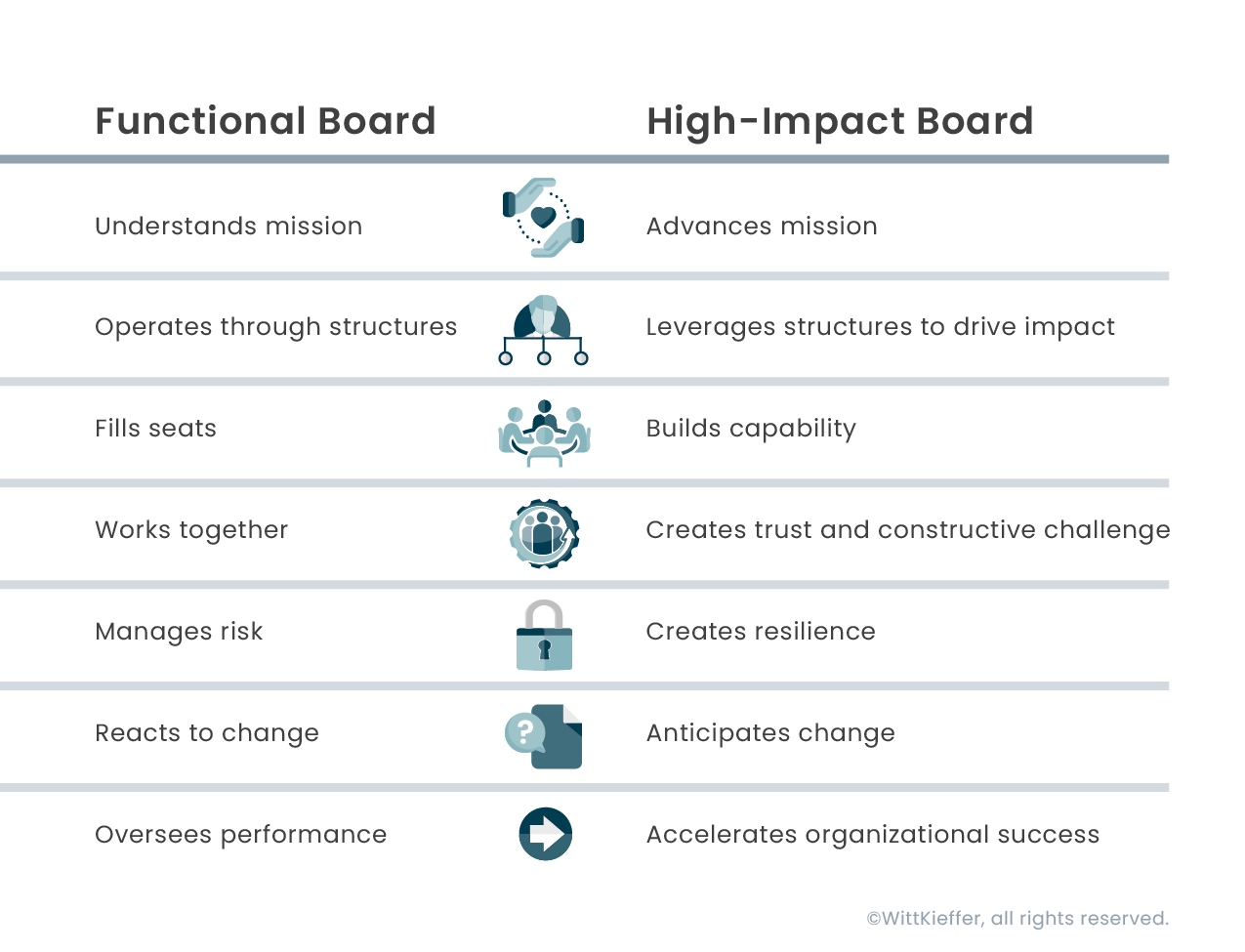
Boards rarely rise (or fall) because of a single governance decision. More often, their effectiveness reflects the cumulative impact of many smaller choices: how they prioritize agenda time, how thoughtfully they recruit and develop board members, how willing they are to challenge assumptions, and how intentionally they invest in relationships and culture. Over time, these decisions shape the board's ability to navigate complexity, make sound judgments, and remain focused on organizational priorities.
Seen through this lens, governance capacity resembles a strategic reserve — what we call a deposit of impact. Every discussion that sharpens strategic clarity, every refinement of committee authority, every thoughtful succession decision, and every investment in board culture contributes to that reserve. Individually, these actions may seem incremental. Collectively, they determine whether a board is prepared when the stakes are highest.
High-impact boards do not wait for crisis or disruption to expose weaknesses. They continuously strengthen their governance foundations, recognizing that resilience, adaptability, and long-term organizational success are built long before they are tested.
High-impact governance is not a checklist. It is a system of purpose, process, people, and culture that creates deposits of impact before organizations are tested.
At its core, the High-Impact Board Framework is not a checklist or even a governance model. It is a way of thinking about governance: one that recognizes that sustainable impact emerges when purpose, process, people, and culture work in concert and evolve over time. When that happens, governance becomes more than a fiduciary responsibility. It becomes a strategic asset that enables organizations to navigate uncertainty, foster innovation, and create lasting value for the communities they serve. In doing so, boards become trusted partners to leadership, stewards of mission, and drivers of long-term performance.
Sources
American Hospital Association (2025). 2025 National Governance Report. AHA Trustee Services.