As lifespans extend and careers lengthen, the implications for how organizations manage talent are becoming increasingly significant. To explore how longevity is beginning to reshape the workplace, we interviewed chief human resources officers across a range of industries, along with longevity researchers.
We expected to find organizations actively rethinking careers and operating models to adapt to extended working lives. However, our conversations revealed a different, more subtle reality: longevity is rarely recognized as a formal part of the transformation agenda. Few organizations even use the term, and even fewer have developed a coherent strategy around it.
That said, many organizations are already grappling with the consequences of longer lives, such as scarce expertise, delayed retirements, more varied career paths, concerns about sustaining performance over time, rapidly changing skill requirements, and increasingly age-diverse teams. While related practices are emerging, they are not yet unified by a common logic or language.
Longevity is not entering organizations through a grand redesign. Instead, it is showing up in a series of cracks in talent systems originally designed for a different demographic and technological era. The opportunity for leaders is to recognize these signals and develop a more integrated approach before they evolve into deeper structural challenges.
This report does not attempt to provide definitive answers. Instead, it aims to surface the questions leaders may need to consider as longer lives begin to reshape the workforce.
Five Cracks in the Traditional Workforce Model
For much of the past century, the prevailing career model has followed a linear sequence: education, full-time work, advancement, and retirement at a largely predictable age. Many of the systems surrounding employment, from learning and job architecture to succession planning and pensions, still adhere to this traditional logic.
Demography is moving in another direction. The World Health Organization (WHO) projects that, by 2030, one in six people globally will be aged 60 or over; by 2050, the number of people aged 60 and above will double, reaching 2.1 billion (WHO, 2025). The labor-market implications are already visible. The Organisation for Economic Co-operation and Development (OECD) describes population aging as a megatrend and identifies employability, opportunity, skills renewal, and job mobility as central to longer working lives (OECD, 2025).
Yet longevity is not simply a question of retiring later. Organizations are beginning to recognize that careers may need to accommodate multiple transitions and periods of growth over longer working lives. Longer healthy lifespans are reshaping how people learn, work, care for others, and pursue new opportunities, often through more fluid and individualized paths. The traditional boundaries separating education, work, retirement, and personal life are blurring, while expectations around careers, contribution, and success continue to evolve.
Across our research, five recurring cracks emerged — signals that the assumptions underpinning work and careers are beginning to change.
1. Experience Is Becoming More Valuable
Organizations have long worried about skills shortages. Longevity changes the question from Where will we find talent? to Why are we allowing expertise to leave?
Experienced team members are increasingly valued for their accumulated wisdom, institutional knowledge, judgment, client acumen, technical memory, pattern recognition, and mentoring abilities — precisely those capabilities that are difficult to codify and often appreciated and missed only after they leave the organization.
Organizations are beginning to address this issue in several ways:
- Transitioning experienced professionals nearing retirement into roles focused on coaching, mentoring, or knowledge transfer.
- Rehiring retired specialists as consultants when their expertise remains critical.
- Identifying positions that rely heavily on a single individual possessing legacy knowledge, often described as a "single point of failure," and treating those roles as succession risks.
- Creating communities for later-career talent that emphasize staying relevant, continuing to learn, sharing knowledge, and supporting younger colleagues.
But retention is not automatically positive. Longer tenure can hinder progression if structures remain rigid, and rehiring retirees at a premium may strain budgets. The goal should be to distinguish tenure from value: which capabilities will matter, where knowledge is at risk, and how experienced talent can contribute without obstructing opportunities for others.
2. Careers Are Becoming Less Linear
The career ladder is losing its descriptive power. Driven by personal ambitions and evolving life priorities, professionals increasingly move laterally, take on stretch assignments, shift between technical and leadership tracks, take sabbaticals or career breaks for caregiving or other commitments, and, in some cases, change professions entirely. Later-career team members may prefer reduced hours, project-based work, or advisory roles over the binary choice between full-time employment and full retirement.
As roles evolve and some disappear, the challenge is no longer how to support a single career journey, but how to enable multiple transitions over a working life that may span five or six decades. Organizations are experimenting with several approaches:
- Creating job families and competency matrices that make expert progression as visible as managerial advancement.
- Designing career paths around distinct occupational realities, recognizing that different groups within the same organization may experience longer working lives very differently.
- Creating multi-hat roles that allow executives and subject-matter experts to train or mentor others while remaining connected to their core role.
- Offering short-term placements across functions or organizational boundaries, international assignments, phased transitions, expert tracks, and re-onboarding pathways for returning retirees.
Experimentation is already happening, but the surrounding architecture has not caught up. Pension rules, employment contracts, pay structures, and succession systems still largely assume upward progression followed by a clean exit. More flexible careers also raise legitimate commercial and organizational questions: Who carries the cost of transition periods? How should different forms of contribution be valued?
The aim is not unlimited flexibility, but structured career optionality, providing enough room for careers to bend without ignoring cost, fairness, succession, or operational complexity.
3. Sustainable Performance Matters More Than Peak Performance
As careers lengthen, the objective can no longer be maximum intensity sustained for as long as possible. It must become renewable performance: the capacity to maintain health, energy, motivation, and employability across multiple decades.
The challenge is particularly acute in roles involving physical repetition, inflexible schedules, emotional strain, or sustained pressure. Organizations are responding with mental-health support, preventive health checks, flexible rosters, job sharing, manager training, psychological-safety programs, and workforce data to identify the underlying patterns of absence and disengagement.
These interventions matter. But many are episodic or kick in only after strain is already visible. A longevity lens pushes the question upstream: from helping individuals cope with demanding work to reconsidering how that work is designed. The question shifts from How do we help people recover? to How do we design work that does not repeatedly deplete them? For some roles, the answer may involve greater autonomy, more deliberate recovery cycles, or changes in workload and pace; for others, ergonomic redesign, altered duties, technology support, or a transition from execution into training and mentoring.
Ultimately, the aim should be to align work with well-being, ensuring that workspan and healthspan evolve together, rather than extending one at the expense of the other.
4. AI Makes Lifelong Learning Non-Negotiable
AI, not longevity, dominated many of our conversations, and this is understandable given the immediate pressure leaders face to automate tasks, redesign processes, and build AI fluency. Beyond near-term productivity gains, organizations recognize that AI will fundamentally reshape roles and workflows by flattening structures, reducing functional silos, and blending human judgment with machine capability.
Both AI and longevity will redesign how work is done. But viewed together, they create a deeper challenge. If careers lengthen while skills become obsolete faster, a one-time educational experience followed by decades of application is no longer viable. The World Economic Forum (WEF) estimates that 39% of workers' existing skill sets will be transformed or become outdated between 2025 and 2030. It calculates that 59 in every 100 workers would require training by 2030 (WEF, 2025).
Organizations are responding by establishing foundational AI learning programs, incorporating AI into leadership development, encouraging talent across all levels to contribute to use cases from the bottom up, and applying technology to repetitive or hazardous tasks. At the same time, people leaders emphasized the continuing importance of judgment, ethical reasoning, relationships, care, negotiation, and contextual decision-making.
The challenge extends beyond skill obsolescence: it also involves unequal opportunities for skill regeneration. Later-career professionals may be overlooked for training or perceived as less adaptable, while earlier-career talent may gain faster access to new tools. On the other hand, earlier-career professionals might become technically proficient without acquiring the context and judgment built through experience.
A learning system designed for longevity must be inclusive of all ages, connected to real work, and accessible throughout one's career. The objective should be to focus on renewing capabilities for the future rather than merely protecting current jobs.
5. Multigenerational Workforces Need Design
Age diversity does not create value by itself. In fact, it creates the possibility of value as well as the possibility of friction.
People leaders described a number of visible disparities emerging in the multigenerational workplace, including differing levels of digital fluency, communication preferences, expectations for progression, attitudes toward flexibility, and the role of purpose in work (and life). They also identified a tension at both ends of the talent pipeline: How does earlier-career talent enter the workforce when AI transforms traditional entry-level work, while experienced professionals remain longer in senior or specialist positions?
It is tempting to explain these tensions using generational labels. Yet in reality, life stage and personal context often matter more than cohort stereotypes. The practical implication is to create dialogue and strengthen mutual understanding rather than categorize people.
Organizations are responding by pairing later-career professionals with earlier-career team members, using mentoring and reverse mentoring, supporting employee-led generational communities, and creating forums in which colleagues compare experiences and working preferences. The most promising examples treat knowledge as reciprocal: experienced team members provide context, judgment, and institutional memory; newer colleagues contribute emerging technical capabilities and fresh assumptions.
The goal should be productive reciprocity, not effortless harmony.
The Real Leadership Challenge
Taken separately, none of these five cracks is new. Leaders have discussed skills, well-being, retirement, career flexibility, and generational differences for years. What is new is their convergence and the tension it exposes between immediate operational pressures and long-term organizational viability.
People leaders are currently navigating urgent demands: deploying AI, filling critical roles, controlling costs, and maintaining workforce engagement and performance. Longevity, by contrast, operates on a decadal scale. It is entirely rational that most organizations address its immediate manifestations rather than architecting a standalone longevity strategy.
Our interviews suggest that many companies already have relevant initiatives, such as mentoring, well-being programs, reskilling, phased transitions, and knowledge-risk mapping, but manage them separately. Even when these initiatives support extended careers, they are rarely understood as elements of a single, integrated system.
The leadership task is not to predict a 60-year career in detail — that would be unrealistic. It is to make near-term choices that preserve longer-term options. Will today's AI investment widen or close age-based skill gaps? Will succession planning transfer expertise or merely replace incumbents?
Leaders must hold two horizons at once: the economics of the next operating cycle and the talent and human-capability needs of the next decade. Longevity becomes strategically useful not as a distant projection but as a lens for decisions already on today's executive agenda.
Beyond Workforce Optimization
For decades, organizations have become increasingly sophisticated at workforce optimization: allocating headcount, standardizing roles, measuring performance, and reducing friction. Those capabilities remain necessary. But extended working lives may require a complementary organizational logic, one focused not only on deploying capability efficiently, but on renewing it over time.
We might call this a regenerative organization, and the term should be understood as an emerging direction, not a proven model. Such an organization would seek to restore and renew human capability across four dimensions:
- Sustainability asks whether work supports healthspan, energy, and the sustainable performance needed for a longer career.
- Adaptability asks whether talent can access continuous learning, move between roles with fluidity, and remain employable despite skills disruption.
- Amplification asks how technology augments human contribution, removing low-value or hazardous work while amplifying judgment, creativity, and connection.
- Contribution asks how organizations value mentorship, institutional memory, and judgment rather than relying only on hierarchy, hours worked, or role-based output.
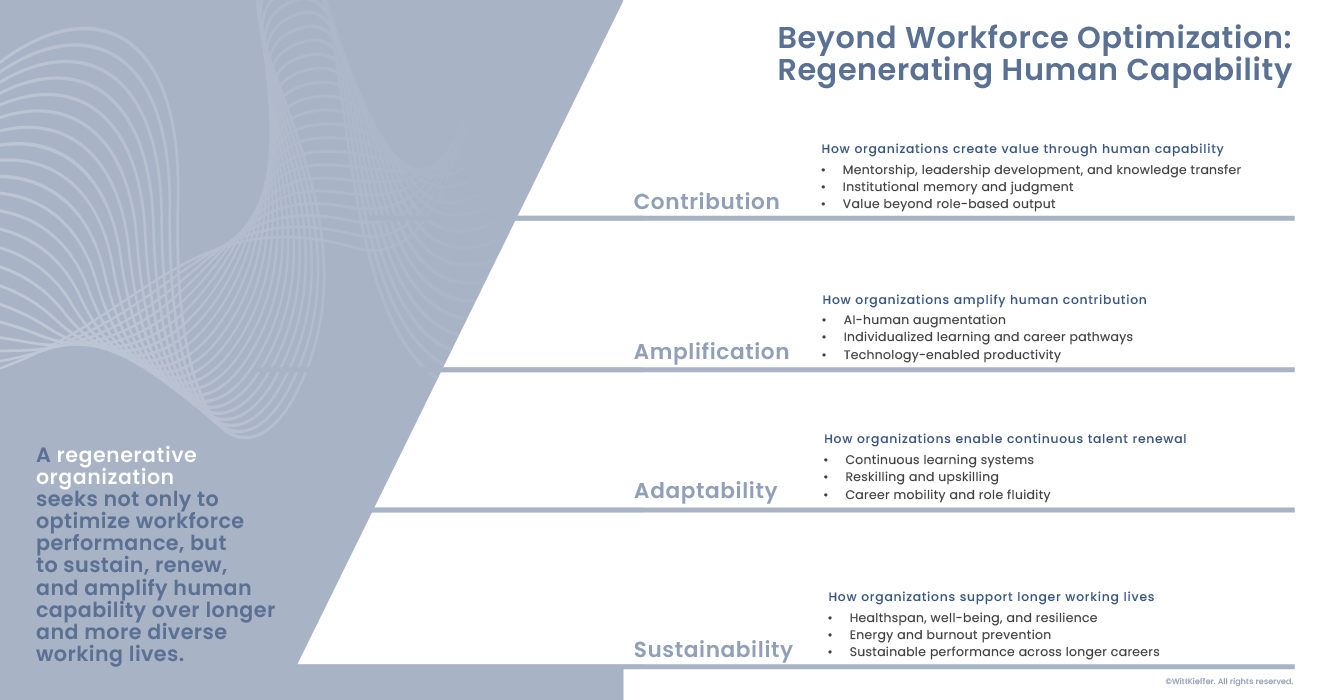
These lenses turn longevity from an abstract demographic topic into practical executive questions. Which roles are becoming difficult to sustain? Who has access to reskilling? Are managers rewarded for renewing capability, or only for consuming it?
A regenerative organization would not promise lifelong employment or remove individual responsibility; nor would it assume that working longer is desirable for everyone. Its objective would be narrower and more realistic: to create conditions in which team members can continue to contribute, adapt, and remain well for as long as that is mutually valuable.
Conclusion
The organizations in our research are not yet redesigning themselves around longevity. That is precisely the point. The transition is underway before the language or the strategy has fully formed.
The early signals are visible in the return of retirees with scarce expertise, the reinvention of expert careers, the pressure to make performance sustainable, the race to renew skills, and the everyday work of enabling different generations to learn from one another. Each can be managed as an isolated talent issue. Together, they reveal that the assumptions underpinning the traditional career are weakening.
The next phase of longevity at work is unlikely to begin with a new title or a new organizational structure. In most cases, it will begin when leaders connect decisions they are already making and ask a longer-horizon question: Are we merely optimizing today's workforce, or renewing the human capability on which tomorrow's organization will depend?
The following interviewees participated in research for this report:
Shalinee Basak, Global HR Executive
Sébastien Boutté, VP, Human Resources, TISSIUM
Anabel Fall, Group Chief People Officer, Haniel
Anton Grove, SVP, People Performance & Development, International Air Transport Association (IATA)
Patricia Jaquet, Chief Human Resources Officer, Clinique La Prairie
Damien Ng, PhD, Thematic Research Analyst, Julius Baer