Introduction: The Shift in Governance Reality
For much of modern higher education history, boards have governed from a posture of institutional caretaking. Their fiduciary responsibilities, the duty of care and the duty of loyalty, were exercised primarily through the preservation of institutional mission, the stewardship of financial assets, and the maintenance of leadership continuity. Governance followed recognizable rhythms: presidential searches occurred once a decade or so, strategic plans were refreshed on similarly long cycles, capital campaigns and major investments commanded periodic attention, and, between these moments, governance remained steady and largely predictable. Trustees were expected to be engaged and accountable, but the implicit assumption was that the institution's underlying trajectory was stable — and that the board's role was to protect and sustain it.
That model no longer holds.
Today, governance in higher education is shaped far less by predictability and far more by sustained volatility, driven by overlapping waves of financial, political, legal, and reputational pressure that arrive with increasing frequency and intensity. Boards are no longer confronting one discrete challenge at a time; instead, they are managing clusters of interconnected, mutually reinforcing pressures, often without clear resolution in sight. The formal role of the board has not fundamentally changed. What has changed is the operating reality: the scale, pace, and complexity of decisions, as well as the level of public scrutiny under which they are made.
Boards are no longer confronting one discrete challenge at a time; instead, they are managing clusters of interconnected, mutually reinforcing pressures.
This report offers a candid snapshot of how trustees are experiencing governance right now. Not as it is articulated in bylaws or idealized in governance literature, but as it actually unfolds in boardrooms across higher education. This report draws on interviews with trustees representing a broad cross-section of institutions, governance models, and board roles across higher education. Despite differences in mission, scale, financial model, and governance structure, their accounts point to a remarkably consistent set of pressures and trade-offs.
What emerges from our interviews is a portrait of boards operating in a governance environment defined by interlocking, time-sensitive challenges. Trustees describe an environment in which nearly every issue presents itself as mission-critical and overlapping, making prioritization increasingly difficult. Many acknowledge that legacy board structures and processes, such as committee configurations, meeting calendars, and information flows, no longer align with the realities they are navigating. Others point to growing difficulty in recruiting and retaining trustees willing to operate in an increasingly contentious and politicized environment. A further constraint is the mismatch between board composition and the expertise required today: many trustees, both new and long-serving, lack deep familiarity with higher education's unique operational and financial characteristics or the specific capabilities now required to contribute effectively. Across conversations, trustees repeatedly return to a central tension: the widening gap between the need for long-term, strategic judgment and the constant pull of immediate problem-solving and, at times, crisis management.
This is not a report about governance failure in the traditional sense. Trustees are not absent or uncommitted. If anything, the opposite is true: the trustees we spoke with are deeply committed and acutely aware of their fiduciary responsibilities. Many describe spending more time than ever on board work, engaging more frequently with leadership, and wrestling with decisions of unprecedented consequence. What cuts across these conversations is a growing recognition that governance models built for a more steady context are being stretched beyond their original design. In practice, boards are often being pulled deeper into operational details and shorter-term problem-solving; whether this represents necessary engagement or a blurring of governance boundaries depends on perspective, but the pattern is consistent.
It is this tension between commitment and capacity, between engagement and structure that the following sections explore. We begin with the expanding set of issues landing on trustees' agendas and the challenge of prioritization in an environment where everything feels urgent. We then explore how boards are governing under these conditions, where traditional models are holding, and where they are fraying. A subsequent section focuses on the board–president relationship, which trustees consistently identify as a decisive factor in navigating disruption, particularly during leadership transitions. The report concludes by considering what this moment now requires of boards as trustees grapple with the shift. The most faithful act of stewardship is adaptation and transformation — and the gravest breach is standing still.
About This Research
This report draws on in-depth, one-on-one interviews with trustees representing a broad cross-section of institutions and governance roles across higher education. Participants included board chairs, vice chairs, committee leaders, and trustees serving public and private institutions, ranging from research universities to regional public institutions and liberal arts colleges. Interview participants also represented a range of governance models, including self-generating, politically appointed, and elected boards.
Insights from the interviews were synthesized to identify recurring themes and patterns across institutions. These findings were considered alongside relevant higher education governance literature, industry research, and sector trends. The analysis presented in this report reflects both the challenges trustees consistently described and the governance implications emerging from those conversations.
Acknowledgement
We are deeply grateful to the trustees who participated in this research. Their candor, time, and willingness to share their experiences navigating governance under conditions of significant disruption provided the foundation for the observations and themes presented throughout this report. To protect confidentiality and encourage open dialogue, neither individual participants nor institutions are named.
Board Agendas Under Strain
Boards across higher education are operating in an environment where multiple pressures compete simultaneously for attention. The defining challenge is not simply the volume of issues before trustees, but their interconnected complexity. Financial dynamics, enrollment volatility, leadership instability, political scrutiny, and public skepticism do not arrive as discrete problems to be solved sequentially. They reinforce one another, making it difficult to address any single challenge in isolation. In this context, prioritization is no longer a technical exercise; it has become a core governance function, one that increasingly shapes institutional direction.
What distinguishes the current moment is that these pressures are not temporary disruptions layered onto an otherwise stable system. They reflect structural shifts reshaping how institutions operate, finance themselves, and define their value. Many institutions are now operating under business models that no longer align with their cost structures or revenue realities, requiring transformations that are difficult to execute within traditional governance frameworks (Rose and Large, 2021). Financial sustainability sits at the center of most board agendas. While stresses in the financial model are not new, they are becoming more visible and harder to offset, as demographic shifts, funding constraints, and market dynamics converge. Revenue models remain under strain as enrollment growth stalls or reverses, and net tuition revenue continues to erode even as sticker prices rise. The issue is less pricing and more realization: the growing delta between what institutions charge and what they collect. At the same time, costs, particularly personnel and aging physical plants, are accelerating. More than half of S&P Global's rated private nonprofit colleges and universities ran operating deficits in 2024, up from the prior year, underscoring that these pressures are enduring rather than cyclical (S&P Global Ratings, 2025).
Demographic and market forces compound that reality. Fall 2025 marked what many analysts describe as a high‑water point for traditional‑aged undergraduate enrollment, reflecting broader demographic trends that are expected to reshape enrollment patterns over time (Education Dynamics, 2025; National Center for Education Statistics, 2026). Modest enrollment gains at some institutions mask uneven market dynamics: enrollment growth at for-profit colleges alongside flat performance at many nonprofit private and regional public institutions, declining graduate enrollment, and reduced international student flows, particularly at the graduate level. Beyond these enrollment shifts, the demographic composition of prospective students is changing, requiring institutions to adapt recruitment strategies and support structures to serve increasingly diverse populations. These pressures are intensified by competitive escalation in facilities, athletics, and program offerings — investments that many institutions feel compelled to make to remain competitive in a shrinking market. Research-intensive institutions, while often maintaining more stable enrollment, face a different but equally destabilizing set of pressures: declining state appropriations and increasingly uncertain federal research funding, which together erode the financial foundation that has historically supported their missions. For boards, these trends unsettle long-standing assumptions about demand, market position, and institutional scale.
As demographic pressure intensifies, boards are also confronting a more fundamental question: does the value proposition of higher education still hold in the eyes of students, families, and the public? Public confidence has eroded over the past decade. In 2025, only 35 percent of U.S. adults described college as "very important" for success, down sharply from 75 percent in 2010; just 22 percent believe the cost of college is worth it if loans are required (Pew Research Center, 2024). Although there was a modest rebound in public trust in higher education in 2025, rising to 42 percent from a recent low (Gallup, 2025), overall confidence remains well below historical norms. Boards increasingly engaged in defending institutional value even as they work internally to redefine it.
Boards spend more time responding to what arrives than shaping what matters.
In parallel, trustees are navigating heightened political, regulatory, and reputational exposure. Issues once peripheral to board deliberations, such as First Amendment considerations, civil rights and Title IX compliance, cybersecurity threats, student wellness and mental health, food insecurity, campus safety and active shooter preparedness, donor and legislative pressure, now routinely occupy board agendas. Regulatory scrutiny has intensified as well: in 2025, the U.S. Department of Education identified more than 400 institutions as financially at risk (Education Dynamics, 2025), a designation that carries implications for accreditation, aid eligibility, and public perception. Governance has become more externally driven, more reactive, and less tolerant of missteps. Artificial intelligence has also emerged as a dual-edged board issue: both a source of operational uncertainty and a strategic opportunity tied to curriculum, workforce relevance, and institutional positioning.
Leadership volatility adds another layer of pressure. Presidential tenures have shortened significantly over the past two decades, with median tenure falling to 5.9 years in 2022, down from 8.5 years in 2006 (American Council on Education, 2023). Transitions occur more frequently, often under compressed timelines and greater public visibility. Interim presidencies have become more common and, in many cases, longer lasting. What amplifies the challenge is the absence of formal succession planning in many institutions. Without advance planning, each transition becomes a crisis, placing added demands on boards to maintain continuity, manage stakeholder expectations, and sustain strategic momentum in the absence of enduring executive leadership.
Taken together, these forces push boards into a mode of governance that is both more demanding and less forgiving than in the past. The issues landing on trustees' tables are not incremental adjustments to a stable model; they are questions of mission, scale, and long-term viability. Boards are being asked to consider programmatic, structural, and strategic pivots that institutions were not designed to execute quickly, often without precedent or shared agreement on what success should look like.
As a result, agendas tend to fill themselves. Immediate challenges crowd out longer‑term discussion. Issues arrive already framed as crises, narrowing the room for reframing or reprioritization. Risk increasingly originates outside the institution — in markets, regulation, politics, and technology — rather than within internal operations. However, the culture of academic governance, rooted in deliberate consensus‑building, remains largely unchanged.
Boards are thus being asked to move faster, decide more often, and assume greater accountability, all while operating within governance structures built for a different era. The result: boards spend more time responding to what arrives than shaping what matters.
The issues landing on trustees’ tables are not incremental adjustments to a stable model; they are questions of mission, scale, and long-term viability.”
How Governance Is Holding, and Where It Is Fraying
The implications of this shift are increasingly visible in how boards operate. Trustees describe a significant increase in board commitment and level of involvement — more meetings, more updates, more informal interactions — yet much of that effort is absorbed by immediate demands rather than long‑term direction. Issues rarely arise in isolation; they intersect and accelerate, requiring response before they can be fully explored. In turn, time once reserved for strategic deliberation is increasingly consumed by near‑term concerns.
Across institutions and governance models, our interviews revealed several recurring patterns, pointing both to where governance continues to function effectively and where existing approaches are beginning to fray.
Operational boundaries under strain. The principle of governance boundaries, the division between board oversight and operational management, remains a widely accepted norm among trustees, even as it is increasingly tested in practice. In periods of uncertainty, financial pressure, or leadership transition, boards can be drawn more directly into operational questions, sometimes with the intention of providing support, and sometimes out of necessity. At the same time, presidents often experience this boundary differently, particularly when increased engagement begins to blur into involvement.
Even so, financial complexity, regulatory exposure, and strategic interdependencies now demand contextual depth that traditional oversight models were not designed to provide. Without that context, oversight becomes limited. Boards are not seeking to manage institutions directly; the tension lies in how to remain at the right altitude while still developing sufficient understanding to exercise judgment.
A call for earlier, clearer engagement. A separate but related issue is timing — not just how boards engage, but when they are brought into the process. The emphasis is on being brought into discussions before options narrow and positions harden, not after decisions are effectively set. Trustees seek clearer guardrails: what decisions belong to management, when board input is expected, and how trade-offs should be surfaced. In this sense, the issue is less about access to information and more about the point in the decision cycle at which the board is engaged.
Culture of constructive challenge and the quality of deliberation. Even when boards are engaged at the right time and with appropriate information, many struggle with a deeper cultural challenge: the shift from informational briefings to substantive deliberation. Historically, many boards operated through "show-and-tell" meetings with limited in-depth discussion or constructive challenge. As stakes have risen, effective governance now requires trustees to probe assumptions, surface competing perspectives, and engage in rigorous debate — both with institutional leadership and with one another.
This shift is not simply a matter of effectiveness; it is also central to the board's fiduciary duty of care, which requires thoughtful preparation, informed judgment, and consideration of alternatives. Still, many board cultures have not fully embraced this evolution in board practice, resulting in engagement that appears active in volume but remains limited in the quality of dialogue and strategic impact.
Decision-making concentrated in executive committees. Executive committees, in particular, are carrying a disproportionate share of responsibility. They are frequently engaged between formal board meetings, addressing fast-moving developments and shaping decisions that are later presented to the full board. While this allows for greater responsiveness, it also creates an asymmetry in engagement. In some cases, this dynamic begins to resemble a "board within a board," with a smaller group developing context and perspective that is not fully shared across the full trustee body. Full boards can struggle to stay connected to the strategic reasoning behind decisions, limiting their contribution to formal approval. This places a premium on ensuring that all trustees remain sufficiently informed and engaged, even when decision-making is accelerated. Over time, this dynamic risks shifting governance from collective deliberation toward a smaller, more transactional core.
Committee structures lacking clarity and evolution. Many boards have expanded their committee architecture over time, often in response to regulatory requirements or emerging issues. However, these structures have not always evolved in purpose or clarity. Committee charters may be outdated or insufficiently defined, and there is frequently overlap across committees. In some cases, committees function primarily as reporting bodies, recycling information rather than advancing focused discussion. The result is a governance system that appears comprehensive but does not consistently support better decision-making.
Information overload, uneven insight. Trustees point to a mismatch between the volume of information provided and its usefulness. Financial and compliance reporting is often detailed and frequent, yet forward-looking insight, particularly on risk, talent, and strategy, is less consistently developed. Boards receive substantial data but not always the synthesis required to interpret it. This creates a paradox: information overload alongside critical blind spots. Discussions can therefore remain anchored in retrospective performance rather than forward-looking risk.
Governance shaped by immediate pressures. These structural and process challenges ultimately play out in how boards use their time. Immediate demands come to dominate board calendars, often crowding out forward-looking discussion, even when boards intend otherwise. This is less a failure of prioritization than a consequence of how issues enter the boardroom — late, urgent, and already framed. Over time, governance becomes more reactive by design rather than by choice, narrowing the board's ability to shape long-term position.
Governance becomes reactive not because boards fail to prioritize, but because issues enter the boardroom late, urgent, and already framed.
In this context, the central question is not whether boards are more engaged than before, but whether their engagement aligns with today's demands. As the next section explores, that alignment, particularly in the relationship between the board and institutional leadership, is a critical determinant of whether governance helps institutions navigate disruption or amplifies it.
The Board–President Relationship as the Make‑or‑Break Factor
Boards govern; presidents lead. In practice, the quality of governance depends less on maintaining that distinction than on how well the board–president relationship bridges it: whether it functions as genuine partnership or defaults to formal protocol. In a modern governance environment, that relationship operates less as a hierarchical reporting structure and more as a system of coordination grounded in a set of interlocking practices that shape how governance works in practice. When it works, decision‑making remains coherent, even amid sustained pressure. When it breaks down, governance quickly becomes fragmented, reactive, and difficult to sustain.
Boards govern; presidents lead. The quality of governance depends less on maintaining that distinction than on how well the board–president relationship bridges it.
Across interviews, this relationship emerged as one of the strongest predictors of governance effectiveness. Leading boards recognize this dynamic and conduct periodic presidential assessments that explicitly evaluate the quality of the board–president relationship alongside performance outcomes, treating relationship health as a governance priority rather than an implicit assumption.
We examine those practices through three lenses:
First, information flow: not simply what boards are told, but when they are brought into emerging issues.
Second, relationship architecture: the role of the board chair–president dynamic in maintaining alignment and stability.
Third, decision‑making dynamics: how boards and presidents work through complex choices, and the extent to which partnership enables or constrains accountability.
Information Flow
The most immediate and visible fault line in the board–president relationship is timing. Trustees consistently emphasize that the issue is not whether boards are informed, but when that information arrives. "No surprises" has become a baseline expectation. Not because disruption can be avoided, but because it can rarely be managed effectively once decisions are already framed or issues have become public.
The distinction between notification and engagement is critical. Boards may receive comprehensive updates yet still find themselves unable to shape outcomes if those updates arrive late in the process. By that point, momentum has already built around a particular direction, and governance becomes an exercise in validation rather than judgment. The result is a subtle but consequential shift: boards remain formally involved, but their influence on direction is constrained.
Relationship Architecture
The relationship between the board chair and the president carries disproportionate influence. In practice, this relationship becomes the primary mechanism through which information is filtered, priorities are aligned, and emerging risks are interpreted.
Where that relationship is strong, alignment extends outward to the full board. Issues are framed earlier, expectations are clearer, and decision-making retains continuity even as conditions shift. Where it is weak, misalignment tends to surface quickly: often first in tone, then in process, and eventually in outcomes. Governance slows down or becomes more contested, and the broader board–leadership relationship becomes harder to stabilize. Trustees also emphasize the board chair's role in enabling difficult conversations: without a skilled and willing chair, critical issues are more likely to be deferred or avoided altogether.
In periods of disruption, this relationship is not simply important; it is structural. It determines whether governance can absorb pressure — or amplifies it.
Decision‑Making Dynamic
The most effective governance environments are defined less by formal roles than by how boards and presidents work together to reach decisions. Trustees are generally clear that they should not operate at a management level, even as some express a pull toward greater involvement in operational matters. At the same time, they recognize that distance alone does not produce effective oversight.
The demand is for engagement that happens earlier — and for decisions that are framed more explicitly. That includes clear articulation of trade-offs, acknowledgment of uncertainty, and visibility into how options are being evaluated. Without that, boards are left to assess outcomes rather than choices.
Importantly, trustees do not view this as a binary choice between partnership and accountability. In contrast, partnership is seen as a condition for accountability. When boards understand context, assumptions, and alternatives, they are better positioned to challenge and refine decisions. When that context is missing, oversight becomes narrower and more reactive.
The difference emerges more clearly under pressure. Where alignment is strong, boards act as thinking partners, helping leadership test assumptions and navigate ambiguity. Difficult decisions become more manageable because they are shared. Where alignment weakens, governance becomes more brittle: roles blur, communication narrows, and confidence erodes on both sides.
As leadership turnover increases and institutional pressures intensify, the board–president relationship is becoming less a matter of style and more a core governance capability. Its effectiveness shapes not only how decisions are made, but whether institutions can navigate disruption with confidence and coherence.
Presidential Succession as a Governance Stress Test
Presidential succession exposes governance strengths and weaknesses more clearly than almost any other moment in the board–president relationship.
Planning gaps remain widespread. Despite the certainty that every president will eventually transition (whether through planned retirement, unexpected departure, or institutional change), many boards do not maintain a formal, ongoing succession process. In practice, succession is often handled reactively, triggered by a departure rather than guided by a long-term plan. This absence is notable given the increasing frequency of leadership transitions and their far-reaching consequences.
Interim leadership is becoming more strategic. Interim presidents are no longer simply placeholders. Boards increasingly rely on them to stabilize institutions, maintain momentum, and buy time for more deliberate decision‑making. In some cases, boards are beginning to consider how to identify or cultivate a bench of potential interim leaders in advance, treating interim leadership as part of risk management rather than contingency.
Internal vs. external selection remains unsettled. Boards do not approach succession with a single model. Some prioritize internal candidates, such as provosts or senior leaders, to ensure continuity and reduce culture and integration risk. Others default to external searches, often based on the assumption that the most suitable candidate will come from outside the institution. These differing approaches frequently reflect underlying, and sometimes unexamined, assumptions about whether institutions need continuity or reset.
Transitions require high‑touch engagement. The board's role does not end with the selection of a president. Effective transitions tend to be highly structured and more hands‑on than anticipated. This can include defined overlap periods between outgoing and incoming leaders, increased frequency of interaction, and an active role for the board chair in onboarding. In some cases, the chair serves as a direct mentor during the early period of a presidency.
Sustaining the presidency is becoming a governance concern. Beyond succession itself, boards are beginning to consider how to support sitting presidents in an environment of sustained pressure and shortened tenures. This includes attention to workload, expectations, and, in some cases, structured opportunities for renewal, such as sabbaticals or planned breaks. While not yet widespread, this reflects a broader shift: leadership continuity is increasingly viewed not only as a transition issue, but as an ongoing governance responsibility.
Combined, these patterns suggest that succession is no longer an episodic governance activity. It is a continuous governance responsibility, one that requires planning, clarity, and a more deliberate approach to leadership stability over time.
What This Moment Requires of Boards
Across interviews, trustees consistently returned to a common question: what does effective governance look like in an environment characterized by continuous disruption? While institutions differ in mission, structure, and governance model, the conversations pointed to several shared priorities for boards seeking to remain effective in a more complex and demanding environment.
Rethinking Governance Effectiveness
Boards today are not only confronting more complex issues; they are doing so under conditions for which they were not designed. Governance structures, processes, and even board composition largely reflect an earlier era, one in which institutional change was slower, risks were more contained, and strategic cycles unfolded over longer time horizons. In contrast, many of the challenges boards now face — financial model pressure, demographic contraction, political scrutiny, leadership volatility — are persistent and externally driven. The result is a structural lag that compounds with each new pressure.
Incremental adjustments are no longer sufficient. Adding more meetings, more committees, or more reporting does not resolve the underlying misalignment. If anything, these responses often reinforce it, consuming more time without meaningfully improving clarity or decision quality. This requires a more fundamental reassessment of how governance functions: how boards set priorities, how they allocate time, and how decisions are framed and sequenced. Many boards are increasingly questioning traditional five- or ten-year planning cycles, shifting toward shorter, more adaptive strategic horizons that better match the pace of change.
Strategic Communication as a Governance Responsibility
One area where this shift is particularly visible is strategic communication. Under conditions of disruption, communication is not simply a management function; it is a governance responsibility. Boards increasingly find themselves navigating not only institutional decisions but also the narratives that surround them, with stakeholders including faculty, students, alumni, legislators, donors, and the public. Clarity, consistency, and timing of communication become central to maintaining institutional confidence.
Designing Governance for Impact
Amid these pressures, the strongest boards exhibit a distinct pattern of behavior. These boards name trade-offs rather than obscure them. They design their time rather than let agendas design them. Most critically, they treat governance as a capability requiring deliberate evolution, not a fixed structure to be defended.
High-impact boards treat governance as a capability requiring deliberate evolution, not a fixed structure to be defended.
This matters because structure is not neutral. It shapes how issues surface, how decisions are made, and what receives attention. In many cases, governance challenges stem not from lack of effort or commitment, but from the persistence of practices no longer fit for purpose. The boards that adapt most effectively recognize this — and act on it. They reconsider committee structures, meeting cadence, and the boundaries between oversight and engagement. In some cases, they take a more deliberate approach to board composition, identifying capability gaps and recruiting trustees with the expertise current conditions demand.
Embedding Continuous Evaluation
Increasingly, this also includes a more deliberate focus on board self-assessment. Proactive boards are moving beyond periodic, compliance-oriented reviews toward more substantive evaluations of how effectively they operate: how decisions are made, how time is used, and how well board structures support strategic priorities. These assessments should ideally encompass both collective board performance and the contributions of individual trustees, recognizing that overall effectiveness depends on both. Independent, third-party perspectives may also be incorporated to provide an external view of board performance and dynamics. Rather than serving as a formal exercise, these efforts create space for reflection, helping ensure that governance evolves intentionally rather than reactively.
These shifts point to a more active conception of governance. Not more operational, but more deliberate — more focused on framing choices, sequencing decisions, and maintaining alignment under pressure. In this sense, governing through disruption is less about doing more and more about doing differently.
What Defines a High‑Impact Board
Institutional contexts differ, but effective governance shares common architecture. Four dimensions consistently separate boards that shape institutional trajectory from those that merely monitor it: WHY, WHAT, WHO, and HOW.
WHY: Purpose and Priorities
High‑impact boards maintain clear alignment between mission, strategy, and decision‑making. They regularly revisit priorities in light of changing external conditions and ensure that board agendas remain anchored to the most consequential issues facing the institution, including long‑term institutional viability and stewardship of mission and public trust.
WHAT: Structure and Process
Effective boards design governance structures to support decision‑making rather than reporting. Committees are streamlined and clearly aligned to strategic priorities, with defined authority and minimal duplication. Meetings focus on forward‑looking discussion, supported by concise, decision‑relevant materials, with clear delegation between board and institutional leadership and early, transparent communication flows.
WHO: Composition and Succession
Board composition reflects current and future needs, not legacy representation alone. High-impact boards take a deliberate approach to renewal, ensuring that trustees bring relevant experience, perspective, capacity, and sustained engagement. They also hold themselves accountable for performance, recognizing that ineffective participation is a governance risk in itself. Succession, both board and presidential, is treated as an ongoing process rather than an episodic event.
HOW: Relationships and Culture
Governance effectiveness ultimately depends on how boards operate together. High‑impact boards foster trust, candor, and constructive challenge. They maintain strong relationships with institutional leadership, particularly the board chair–president dynamic, and within the board itself, and create space for open dialogue before decisions are finalized. They balance confidentiality with transparency, engage with discipline, and approach decisions with inquiry rather than certainty.
Four Conditions for High-Impact Governing Boards in Higher Education
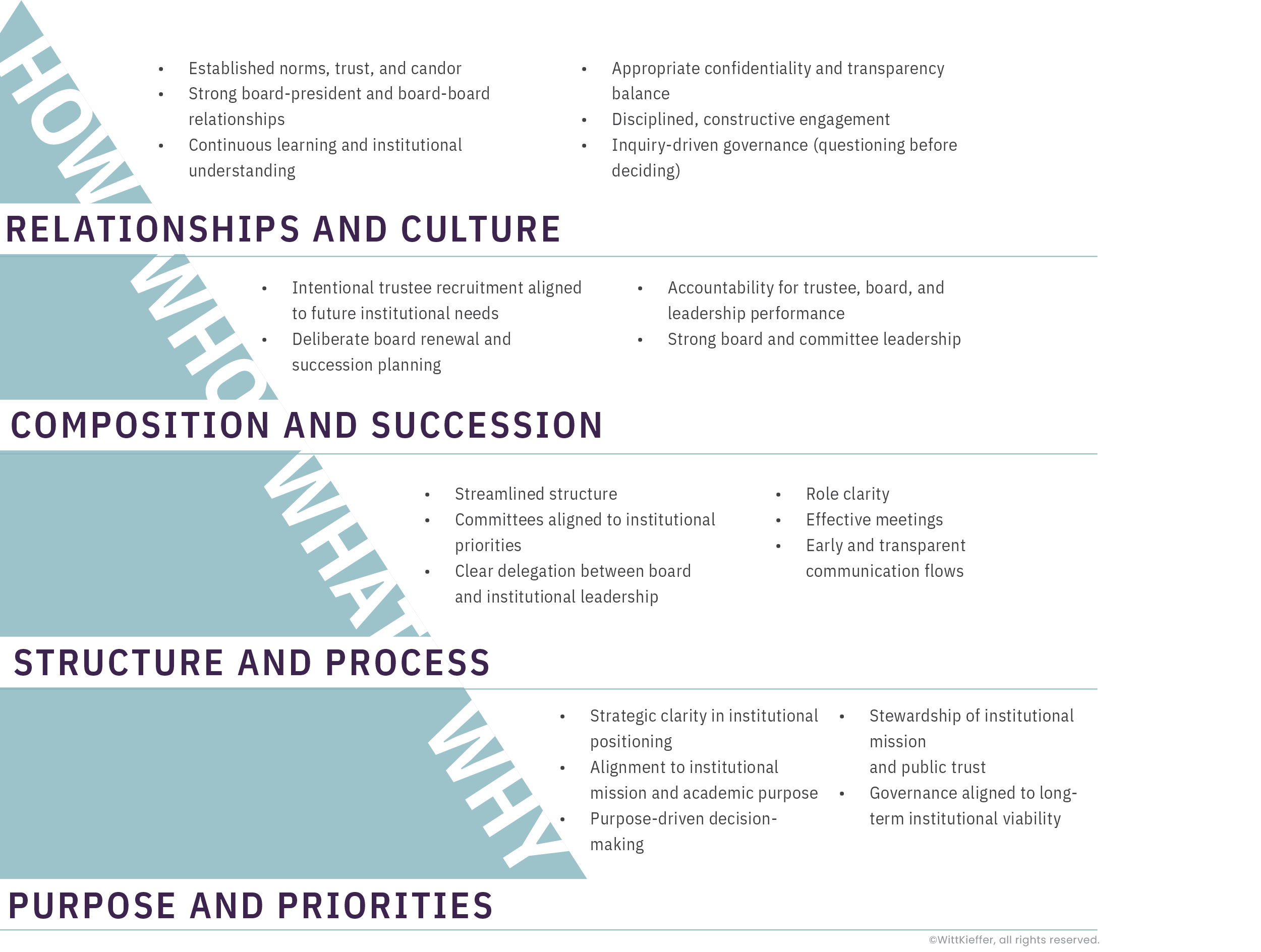
These dimensions highlight that governance effectiveness is not defined by structure alone. It is the interaction between purpose, design, people, and culture that enables boards to move from oversight to impact.
Conclusion: Governing at the Pace of Change
The conditions facing higher education are no longer intermittent; they are persistent. Disruption is not a phase to manage through, but a context to govern within. Governing through disruption has become a core competency of contemporary boards — as has the ability to identify and appoint trustees and presidents who can operate credibly in that environment.
Change is certain. The question is whether boards will lead governance evolution or be forced into it. The pressures institutions face — financial, demographic, political — are structural and ongoing. What distinguishes effective boards is not whether they face these pressures, but how their governance structures enable them to navigate them.
That requires more than greater engagement. It requires a shift in how boards operate: from monitoring to shaping, from reacting to framing, from preserving models to evolving them. High-impact boards are clear on why they govern, anchoring decisions in mission and priorities; deliberate about what they govern, focusing attention on the issues that matter most; intentional about who is at the table and the capabilities they bring; and willing to revisit how they operate together. They are explicit about trade-offs, disciplined in how they use their time, and able to engage earlier, frame decisions more clearly, and remain aligned when it matters.
In an environment defined by continuous disruption, governance is no longer simply a mechanism for preserving stability. It is a capability that enables institutions to respond to change.
The institutions best positioned to navigate the years ahead will be those whose boards treat governance itself as adaptive. Not by abandoning fiduciary principles, but by recognizing that fidelity to mission now requires flexibility in method. In an environment defined by continuous disruption, governance is no longer simply a mechanism for preserving stability. It is a capability that enables institutions to respond to change.
WittKieffer Contributors
This report was developed through a cross-functional collaboration among WittKieffer’s leadership and board advisory, executive search, and strategy and insights teams. The integration of sector knowledge, governance expertise, and research-based analysis helped shape both the direction of the research and the findings presented throughout this report.
Charlene Aguilar, Senior Partner, Education
Ryan Crawford, Senior Partner, Education
Cathy Dove, Ed.D., Principal, Leadership Advisory, Education
Robin Mamlet, Senior Partner, Education
Laura Orr, Senior Partner and Global Board Advisory Leader
Christine Pendleton, Senior Partner, Education
Melody Rose, Ph.D., Senior Partner, Leadership Advisory, Education
Zach Smith, Ph.D., Executive Partner and Market Leader, Global Education
Suzanne Teer, Senior Partner, Education; WittKieffer Board Member
Sources
Rose, Melody and Large, Larry (2021). Higher Education Business Models under Stress: Achieving Graceful Transitions in the Academy. Association of Governing Boards of Universities & Colleges