From Financial Steward to Strategic Architect
The role of the Chief Financial Officer (CFO) in healthcare has undergone a profound shift over the past few decades. Long regarded as a centrally important yet largely functional leader responsible for accounting, reporting, capital stewardship, and financial controls, the CFO now sits at the core of enterprise leadership. In many health systems today, the CFO operates at the intersection of strategy, operations, and financial performance, actively shaping the organization's direction and long‑term viability.
As consolidation accelerates and business models become more complex, financial decisions are no longer merely downstream consequences of strategy; they are central to how strategy is defined, tested, and executed.
Three converging forces help explain why the CFO role has expanded in both scope and impact.
Scale: The Leadership Implications of Consolidation
Horizontal consolidation across health systems materially increases the scale and complexity of the CFO mandate. System CFOs now oversee multi‑state enterprises that include hospitals, ambulatory networks, physician organizations, and, increasingly, insurance products and post‑acute platforms. These portfolios span diverse payer mixes, regulatory environments, workforce dynamics, and community expectations.
"The CFO role has fundamentally shifted from being called in after the deal is baked to asking 'does this make sense?' from the beginning. I find myself leading from the front rather than from the back."
Effectively managing financial performance across this breadth requires more than technical proficiency. It demands the ability to integrate disparate operating models, weigh trade‑offs across markets, and maintain coherence within a geographically and administratively dispersed enterprise. At this scale, the CFO orchestrates priorities across competing strategic and operational demands, often on compressed timelines and with incomplete information.
Scope: Centralization and Its Unintended Effects
Vertical consolidation shifts many core finance and administrative functions to the system level. Areas such as treasury, revenue cycle management, supply chain, analytics, and financial planning, once embedded within individual hospitals, are increasingly centralized under enterprise leadership or managed through external vendors. This is often accompanied by the addition of new responsibilities, including information technology, real estate and facilities strategy, shared services platforms, joint ventures, and business line reconfiguration.
One of my biggest areas of growth has been learning to use influence. Making decisions within your own domain is table stakes for a CFO. The real leadership challenge is shaping outcomes beyond your direct scope — across the organization and into the broader industry."
This shift expands the formal remit of the system CFO well beyond traditional finance. However, it also introduces a significant challenge: the narrowing of strategic exposure at the hospital and entity level. As decision‑making authority and functional complexity shift upward, fewer local leaders gain the breadth of experience previously associated with readiness for system‑level CFO roles. The result is a fundamentally altered pipeline in which the traditional progression from hospital CFO to system CFO is no longer the default pathway.
Complexity: Finance as a Strategic Discipline
Healthcare‑specific complexities elevate the strategic demands placed on financial leadership. Reimbursement volatility, the shift toward value‑based care, regulatory pressure, and sustained margin compression create challenges that cannot be addressed through cost control or financial optimization alone.
CFOs are increasingly engaged in questions once considered adjacent to finance: how to structure population health strategies, how to evaluate alternate care delivery models, how to prioritize capital in an environment of constrained returns, and how to balance short‑term performance with long‑term mission sustainability. While financial discipline remains critical, it is no longer sufficient on its own. Judgment, integration, and strategic foresight are now equally essential.
In many systems, CFOs now play active roles in facilities and operations strategy, clinical integration initiatives, partnership and affiliation design, and enterprise governance. Their influence extends across the organization, not because they own every decision, but because financial considerations increasingly underpin the choices leaders must make.
As organizations scale and authority diffuses, the nature of CFO leadership also changes. CFOs are less able — and less expected — to lead solely through hierarchical structures. Instead, their impact depends on their ability to build trust, frame trade‑offs, and communicate financial realities to a wide range of stakeholders, including clinicians, boards, and community leaders. Leadership is exercised through influence rather than control, integration rather than oversight.
The evolution in role design has important implications for how CFOs are developed, how they are selected, and how organizations structure financial leadership more broadly. Drawing on in‑depth interviews with sitting healthcare CFOs across diverse system models, and informed by decades of CFO search, assessment, and leadership advisory work in healthcare, this report examines those implications in greater depth. We explore the capabilities required for success in this role, the pathways that prepare leaders to thrive, and the organizational choices that enhance the impact of CFOs.
Our Contributors
We are deeply grateful to the Chief Financial Officers who generously shared their time, experiences, and insights for this research. Their candor and real‑world expertise form the foundation of this report, and we extend our sincere appreciation for their willingness to engage in thoughtful dialogue on the challenges and opportunities shaping the future of healthcare finance.
Jennifer Alvey, Senior Vice President and Chief Financial Officer at Indiana University Health
Adam P. Anolik, Chief Financial Officer at University of Rochester Medical Center
Mike Blair, Senior Vice President and Chief Financial Officer at CentraCare
Mark Bortnem, Chief Financial Officer at Essentia Health
Richard Carrico, Chief Financial Officer at Baptist Health
Matthew E. Cox, Executive Vice President and Chief Financial Officer at Corewell Health
Dennis E. Dahlen, Chief Financial Officer at Mayo Clinic
Robin Damschroder, Executive Vice President, President of Value-Based Enterprise, and Chief Financial Officer at Henry Ford Health
Weldon Gage, Executive Vice President and Chief Financial Officer at Texas Children's
Scott Hawig, Executive Vice President and Chief Financial Officer at BJC Health
Todd Hofheins, Chief Financial Officer at UCHealth
Matt Huff, Executive Vice President and Chief Financial Officer at Geisinger Health
Dawn Javersack, Senior Vice President and Chief Financial Officer at Nicklaus Children's Health System
Alec H. King, Executive Vice President and Chief Financial Officer at Memorial Hermann Health System
Warren Ladner, Senior Vice President and Chief Financial Officer at Southern Illinois Healthcare
Matthew Streeter, Chief Financial Officer at North Country Healthcare
Andrew Zukowski, Chief Financial Officer at ECU Health
The Modern Healthcare CFO: Leading Performance and Value
The role of the healthcare CFO is no longer defined primarily by financial oversight. While accounting rigor, reporting integrity, and compliance remain essential, they now serve as the baseline of the role rather than its defining features. Today's CFO is increasingly expected to shape enterprise performance by guiding investment decisions, balancing risk with growth, and ensuring that financial realities inform strategic choices across the organization.
This repositioning changes how CFOs allocate their time and engage in leadership discussions. Financial leaders are no longer brought in solely to validate decisions after the fact. Instead, they are involved earlier and more deeply, helping frame trade‑offs, test assumptions, and translate strategy into financially durable choices. As a result, the CFO role functions less as a control mechanism and more as an integrative one, linking financial discipline with overarching enterprise direction.
Contemporary CFO Leadership Framework
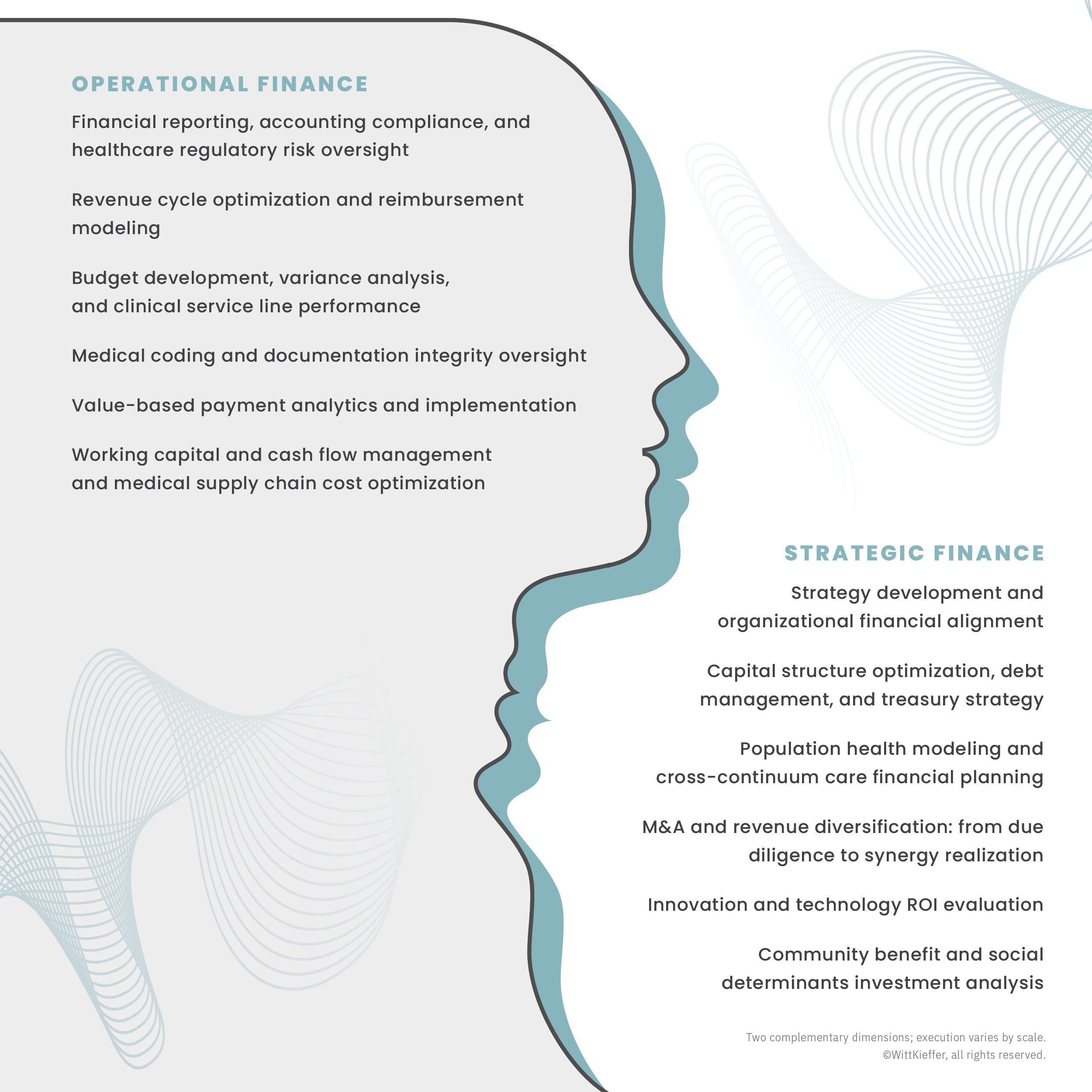
At the core of this evolution is the ability to lead across two complementary domains: operational finance and strategic finance.
Operational Finance: The Foundation
Operational finance is the cornerstone of credibility and effectiveness. Financial reporting, revenue cycle performance, budget discipline, compliance, and cash management continue to anchor organizational stability. Without confidence in these fundamentals, credibility quickly erodes. Disciplined execution in these core areas remains essential.
Strategic Finance: The Differentiator
To be effective, system CFOs have to be highly strategic and comfortable integrating finance with other functions. The role is becoming much more outward-facing — forging market relationships, helping the board navigate change. Leadership, not technical finance expertise, will continue to define success.
In many large, integrated organizations, CFOs play a central role in shaping enterprise‑level decisions through strategic finance. This includes capital structure and debt strategy, mergers and acquisitions, post‑transaction integration, and large‑scale technology and analytics investments. In some systems, CFOs oversee information technology directly; in others, they operate in close partnership with CIOs, particularly as AI and automation move from experimentation to operating reality. Many are also deeply involved in structuring joint ventures, payer partnerships, and alternative care models that reposition the organization within its market.
Though the exact split varies by individual leader and organizational context, strategic finance now occupies an estimated 50 to 60 percent of the CFO role, a notable shift from a decade ago, when operational finance dominated the responsibilities. This reallocation reflects rising expectations for enterprise leadership. The balance continues to shift, particularly at the system level, where portfolio management, capital allocation, and integration work demand sustained strategic attention.
You can stay in a traditional finance role and arbitrate according to the rules, or you can help people understand the why and create systems that allow the organization to be agile. If you create agility, the organization can run faster.
The distinction between operational and strategic finance is not a division of labor; rather, it represents a dual leadership mandate. Operational finance ensures stability, transparency, and trust in the numbers, while strategic finance shapes direction, aligning financial logic with clinical priorities, operational realities, and market dynamics. Effectiveness hinges on the ability to move deliberately between the two: knowing when detail matters and when it is more important to frame the broader question; when discipline must prevail and when flexibility is required.
In practice, this dual mandate is facilitated by changes within finance organizations themselves. As health systems scale, finance functions become more layered and specialized. Chief Accounting Officers, revenue cycle leaders, treasury teams, and operational finance partners now manage much of the day‑to‑day execution with clearer accountability. This structural maturation creates strategic lift, allowing CFOs to focus more deliberately on enterprise‑level questions.
Execution also varies by organizational context. System‑level CFOs tend to spend more time on portfolio decisions, capital allocation across markets, and enterprise integration. By contrast, entity‑level CFOs and those in smaller health systems remain more closely tied to operations and service‑line performance. Regardless of scale, however, the shift toward strategic finance is apparent.
Looking Ahead: The CFO Role in 2030
The trajectory is clear: the CFO role will continue to converge with strategy and operations. In some organizations, this convergence results in hybrid CFO‑COO models or expanded roles that formally link financial and operational performance. In others, CFOs assume broader responsibility for strategy, business development, technology investment, or system integration, operating less as functional leaders and more as enterprise performance executives.
We try to be trusted financial partners and strategic advisors, helping the system think long-term, build strong short-term execution, and work closely with operations, strategy, HR, IS, nursing, and medical leadership.
Several capabilities will become increasingly vital. While data fluency has always been essential, CFOs are now expected not only to interpret complex information but to translate insights into action across diverse stakeholders. AI literacy is emerging as a leadership requirement; this is less about technical expertise and more about judgment: understanding where automation creates value, where risk must be managed, and where human judgment and decision‑making stay essential. Partnership orientation will also define effectiveness, as CFOs must work across functions, build coalitions, and lead through shared understanding rather than authority.
For boards and executive teams, this evolution raises the bar. CFOs are no longer measured solely by the accuracy of reporting or the strength of controls, but by their ability to contribute meaningfully to enterprise decisions. Financial performance continues to be critical, but it is increasingly understood as a means to sustaining mission, enabling investment, and building organizational resilience.
The cost of not adapting is significant. CFOs who maintain a narrow focus on operational finance risk becoming disconnected from the strategic conversations that shape organizational direction. Organizations that do not develop or recruit CFOs with strategic capabilities will face increasing constraints in navigating the complexity and competitive intensity characteristic of today's and tomorrow's healthcare environment.
Beyond the Finance Function: How CFOs Build Trust and Drive Change
Technical mastery is a prerequisite for the CFO role, but it is no longer the sole distinguishing factor for effective leaders. What sets high‑impact CFOs apart is their ability to influence across the enterprise: shaping decisions, building credibility, and driving change in areas where they hold no direct authority.
The true measure of a good CFO lies not just in the outcomes, but in the story they tell. It's about crafting a narrative that allows you to steer the presentation and messaging. In a room filled with board members and diverse stakeholders, the ability to keep the conversation on track is a rare skill, difficult to teach but essential to master.
In large, complex health systems, authority is distributed across clinical, operational, academic, and administrative domains, each with its own priorities and boundaries. In this environment, the CFO's impact depends less on command and more on trust: trust in their judgment, consistency, intent, and ability to integrate financial perspective into broader organizational goals.
Communication as a Strategic Capability
For modern CFOs, communication is not just an ancillary skill but a core leadership capability. The challenge lies not in a lack of data or analysis but in how effectively that information is translated for different audiences.
High‑performing CFOs are deliberate about how they frame issues. Instead of leading with spreadsheets or conclusions, they focus on context: identifying the problem being solved, the trade‑offs involved, and the choices at hand. This is especially critical in executive and board settings, where a CFO's influence often stems from shaping the understanding and discussion of issues rather than merely presenting outcomes.
With the external pressure hospitals face, CFOs have to clearly communicate with boards, physicians, and executive colleagues. Taking a complex topic, simplifying it, and making it clear — that's the hardest skill to develop.
Narrative matters. A well‑constructed financial story fosters shared understanding, clarifies consequences, and promotes alignment. Whether explaining reimbursement pressures to clinicians, capital prioritization to boards, or margin variability to operational leaders, effective CFOs communicate clearly without oversimplifying. They translate financial logic into language that resonates with each audience's perspective, allowing decisions to advance without confusion or defensiveness.
Communication skills are rarely developed through formal training. Rather, they emerge from experience and repeated exposure to high‑stakes conversations, where financial leaders learn what resonates and what does not, refining their style over time. Those who excel in communication often seek out these moments rather than avoiding them, using dialogue as a tool to build credibility long before difficult conversations arise.
Deep Integration Across the Organization
The most impactful CFOs do not stay on the sidelines; they immerse themselves in the organization. They engage deeply with clinical and operational leaders, participating in discussions about access, throughput, staffing models, quality, and care delivery redesign. The primary aim of this involvement is to build context, not to expand control.
By closely collaborating with non‑finance leaders, CFOs develop the operational fluency needed to connect financial outcomes to real‑world dynamics. They understand how patient flow affects revenue cycle performance, how workforce decisions shape margin sustainability, and how quality initiatives influence long‑term cost structures. These insights allow them to contribute to operational discussions as partners, providing financial perspectives without dominating the conversation.
One of my biggest challenges has been getting people to slow down. We had a 'just do it' mentality, but data-driven decision-making requires taking time to dig deeper and analyze issues before deciding.
This requires an intentional shift in how CFOs view internal stakeholders: not as recipients of financial constraints, but as collaborators in problem‑solving. Such a mindset changes how financial realities are introduced. Instead of positioning finance as a gatekeeper, effective CFOs frame constraints as shared challenges and work jointly to identify viable paths forward.
This approach requires curiosity and humility. CFOs must be willing to engage in domains where they are not the content experts, asking questions that reveal assumptions and clarify implications. The goal is not operational mastery, but informed engagement — operating at a level where financial insight can meaningfully improve decision quality.
Leading Change Without Direct Authority
Perhaps the most demanding aspect of the modern CFO role is leading change in areas where authority is diffuse or indirect. Capital reallocation, cost transformation, service line redesign, and technology investment often sit at the intersection of multiple stakeholders, each with legitimate concerns and competing priorities.
In these scenarios, influence is built through credibility rather than authority. Impactful CFOs invest time in educating leaders across the organization by fostering shared financial literacy and helping others understand the implications of their decisions. This is not about enforcing discipline from above, but about enabling better decisions at all levels.
Resistance is inevitable, particularly when financial realities require trade‑offs or difficult choices. Successful CFOs engage resistance directly and constructively. They listen carefully, acknowledge concerns, and adjust framing without compromising financial integrity. Emotional intelligence, patience, and consistency matter as much as analytical rigor.
A great CFO protects the CEO from themselves. You need the courage to walk into the office and say, 'I don't think this is a good idea — and here's why.' That kind of truth-telling only works when you challenge respectfully, from a place of wanting the organization to succeed.
Trust accumulates over time. CFOs who are transparent, follow through on commitments, and align financial recommendations with the organization's mission earn the latitude needed to influence decisions outside their formal remit. Once this trust is established, the CFO's voice carries weight; not because of position, but due to their reliability and judgment.
Equally important is the courage to challenge assumptions. High-impact CFOs do not merely go along with consensus; they identify risks, question assumptions, and provide alternative perspectives when financial logic demands it. Effectively doing this requires discernment: knowing when to advocate strongly, when to be patient, and when to support a decision even in the face of uncertainty.
The most effective healthcare CFOs operate with a leadership model that blends credibility, integration, and influence. They communicate with clarity, engage beyond the finance function, and build trust through consistent and principled actions. As healthcare organizations continue to grow in scale and complexity, these leadership competencies become essential rather than optional. CFOs who cannot operate through influence will find their impact limited, regardless of their technical skills.
The Talent Equation: Pathways, Pipelines, and Gaps
Demand for strategic CFO capability is rising faster than the system's ability to develop it. The result is not simply a tighter recruiting market, but a widening mismatch between how CFOs are typically prepared and what the role now requires at enterprise scale.
Career Pathways to the System CFO Seat
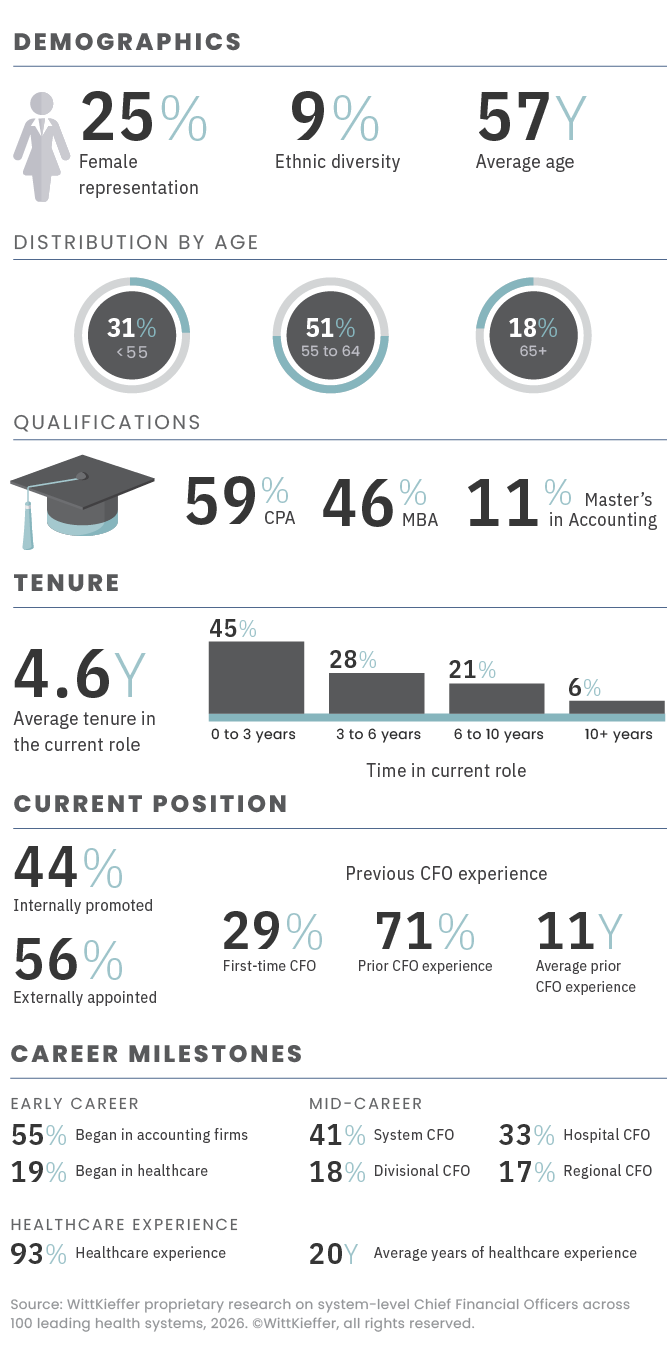
The profile of system-level CFOs still reflects a strong foundation in classic finance. In the cohort of 100 leading health systems, 55% began their careers in accounting firms, and professional credentials remain common, including 59% with CPA certification and 46% holding an MBA. These early foundations matter as they build technical credibility and financial discipline, but they no longer distinguish leaders once they reach enterprise roles. That differentiation increasingly comes from breadth: exposure to operations, strategy, technology, payer dynamics, and complex stakeholder settings.
In hindsight, what has truly prepared me for my current system CFO role are all of my life experiences, not just my previous positions as a CFO. I draw more on my background in education, psychology, banking, and human resources than on financial acumen, and those skills are tested every day.
Mid‑career pathways reinforce that point. Many CFOs have progressed through roles that build scope and complexity across different levels of the system: system CFO (41%), hospital CFO (33%), divisional CFO (18%), and regional CFO (17%) experiences appear across the cohort. The progression remains largely linear within finance, but is increasingly complemented by experience outside the function. Lateral moves into managed care, technology partnership, transformation, or broader administrative responsibility serve as critical proof points of a leader’s ability to operate at the enterprise level and influence across the organization.
What comes after the CFO role also illustrates how the seat is changing. Some leaders move toward CEO or COO pathways or broader enterprise portfolios, while others extend influence through boards, advisory work, or interim roles. The common thread is that the CFO seat is becoming a platform for enterprise leadership, not just a functional endpoint.
The Finance Talent Pipeline Challenge
The pipeline constraint is not only a question of volume, but of readiness at scale. In the top‑100 cohort, 56% of current CFOs are external appointments and 71% bring prior CFO experience, indicating that many organizations continue to rely on externally sourced, already‑proven leaders rather than advancing talent from within. At the same time, CFO tenure is relatively compressed: average tenure in the role is 4.6 years, and 45% of CFOs are within the first three years in the position. Shorter tenure can create compounding effects: fewer cycles of successor development, less continuity in building a bench, and greater pressure to recruit externally rather than develop internally.
Leadership requires a 'broad–narrow–broad' development arc. We need early-career curiosity to mature into world-class specialty expertise, which must then expand again to translate market forces into strategic initiatives. True leadership is forged in that transition from niche mastery to organizational impact.
The strain is most acute in smaller and rural markets. In many cases, limited local benches, repeated turnover in finance director roles, and insufficient bandwidth for onboarding create a cycle of burnout, turnover, and repeated vacancies that becomes self‑reinforcing.
At the same time, some organizations are broadening sourcing. CFOs increasingly come with early experiences outside traditional provider finance, including banking and other sectors, while still bringing significant healthcare exposure overall (the cohort shows 93% with healthcare experience and an average of 20 years). Expanding the candidate lens is rational, but it does not eliminate the learning curve.
While technical expertise in accounting and finance is critical, it's the soft skills that truly determine success. For my team, I seek individuals with a proven track record of teamwork, innovation, and a collaborative spirit. Those who have the ability to develop others and share their expertise are the ones who will thrive and make a lasting impact."
Healthcare finance expertise remains unusually industry‑specific. Understanding reimbursement, payer accounting, and the operational realities behind clinical and financial performance takes years; even technically strong candidates can struggle to translate their expertise without a lived healthcare context.
Where technical pipelines are strong, the most persistent gaps are leadership gaps, particularly as CFOs are expected to influence across clinical and operational domains and operate comfortably amid ambiguity. Three capabilities consistently emerge as harder to build than technical expertise.
Strategic thinking and comfort with ambiguity. CFO leadership increasingly requires guiding decisions under uncertainty, adapting as assumptions change, and helping the organization make informed trade‑offs without perfect data.
Communication and narrative control. Many CFOs describe communication as the single hardest skill to develop — not presentation polish, but the ability to frame issues, shape the direction of board and executive discussions, and translate complex trade‑offs into language that aligns diverse stakeholders. These skills are difficult to teach formally and are built through repeated exposure, modeling, and practice in high‑stakes environments.
Human leadership skills that technology does not replace. AI and automation can accelerate analysis and reduce manual work, but they do not solve the leadership gap. Teaching, coaching, partnership‑building, and change leadership remain human tasks, particularly when decisions affect culture, clinical practice, or long‑standing operating norms.
While technical skills are a given for success in finance roles, emotional intelligence is paramount. It's critical to have the self-awareness to recognize your strengths and areas where support is needed — and the courage to ask for help
The risk is underinvestment in development while expectations accelerate. Development is still largely experiential and informal: leaders learn by being placed into complexity, making mistakes, and gradually finding their voice. That approach can produce exceptional CFOs, but it does not scale reliably.
What this implies: If organizations want more CFO‑ready talent, they cannot rely on traditional progression alone. They need deliberate pathways that combine operational finance mastery with structured exposure to enterprise initiatives, boards, managed care complexity, technology partnership, and cross‑functional leadership, supported by mentorship, coaching, and peer learning that accelerates judgment formation.
The CFO talent equation is tightening. The role is evolving faster than the pathways designed to produce it. Organizations that continue to treat development as informal and episodic will remain dependent on external, ready‑made leaders. Those that build deliberate, enterprise‑level development systems will not only deepen their benches, but shape the next generation of CFO leadership on their own terms.
Organizational Choices That Enable Impactful CFO Leadership
The expansion of CFO expectations is widely recognized. What is less frequently acknowledged — and increasingly decisive — is that CFO effectiveness is shaped as much by organizational design as by individual capability. Development pathways, team structure, role definition, and transition support can either amplify a CFO's impact or constrain it, regardless of talent.
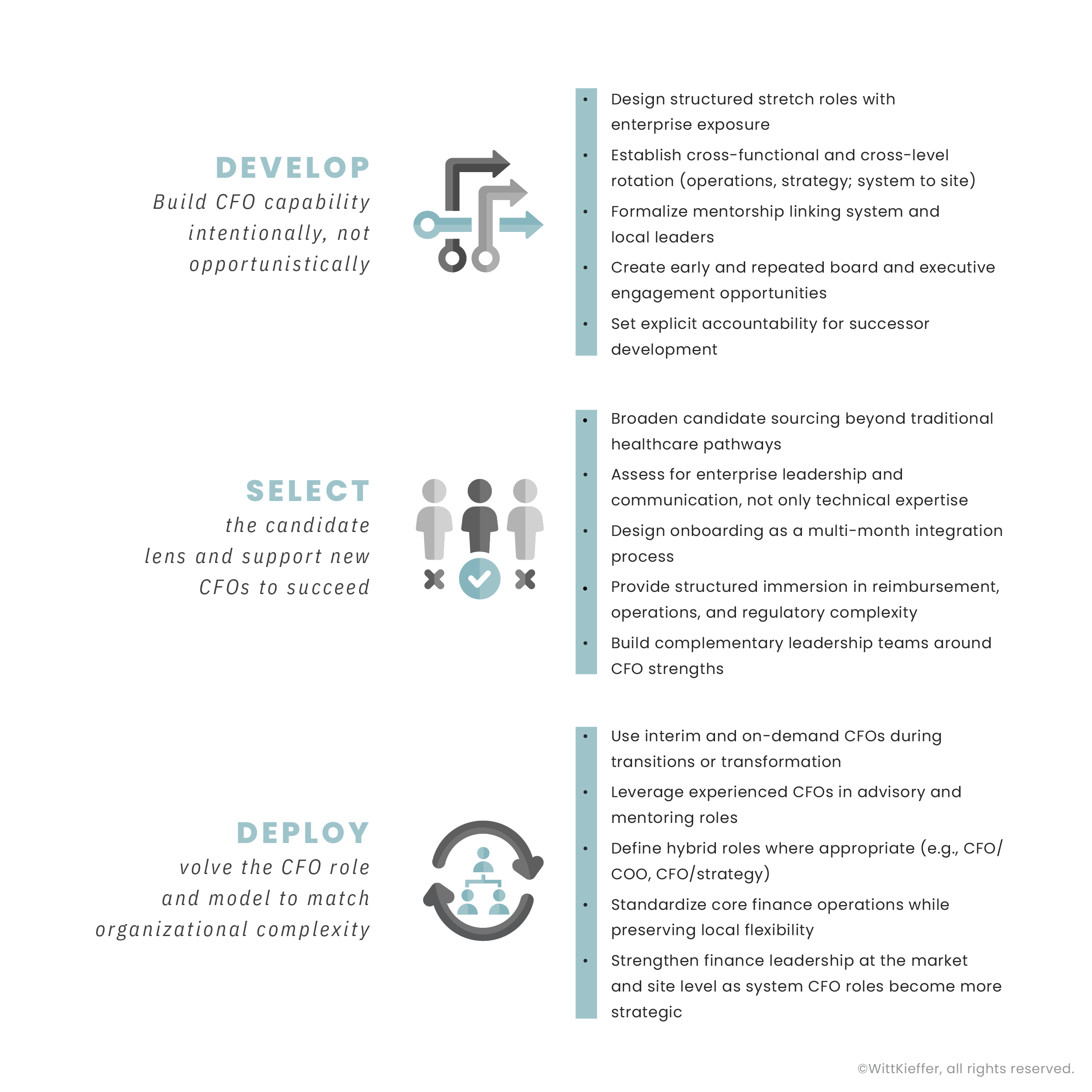
The choices that matter most fall into three categories: DEVELOP, SELECT, and DEPLOY.
Designing for CFO Impact
Organizational Levers That Matter Most
The effectiveness of the modern CFO depends not only on individual capability, but on the extent to which organizational design enables that capability to translate into impact.
DEVELOP: Build CFO Capability Intentionally, Not Opportunistically
CFO capability is largely developed through experience. However, too often that experience is left to chance, and development remains informal, dependent on individual initiative and opportunistic exposure rather than structured programs.
Organizations building stronger pipelines take a more deliberate approach across several dimensions. They design structured stretch roles that provide early exposure to enterprise complexity, including integration efforts, value‑based contracting, digital transformation, and strategic partnerships, where finance leaders must operate beyond their functional comfort zone and build credibility across stakeholders.
We grow our people to a point where they can step into my role or similar roles elsewhere. If they move on to become leaders at other organizations, that isn't a pure loss — it's also a dividend in seeing trusted colleagues in other organizations. True impact is building a bench strong enough to be recognized by the entire industry.
They also formalize rotation across finance, operations, and strategy, and between system and site roles. The goal is not movement for its own sake, but breadth with purpose: repeated opportunities to practice enterprise thinking, build operational fluency, and understand how decisions land across the organization.
Mentorship is another area where a more intentional approach differentiates leading organizations. Mentorship between system and site leaders is common, but often unstructured; more advanced models make it explicit by defining progression expectations, creating feedback loops, and tying development to real enterprise work — not classroom learning alone.
A further lever is board exposure. Communication and narrative control are consistently among the most difficult capabilities to develop and among the most critical for success. These skills are rarely built late in a career; they require early and repeated board‑and executive‑facing experience, supported by coaching and feedback over time.
SELECT: Expand the Candidate Lens and Support New CFOs to Succeed
As internal pipelines struggle to keep pace, recruitment strategies are broadening. The cohort already reflects diverse early-career origins, while still showing deep healthcare experience in most cases. The practical implication is not simply to hire differently, but to onboard differently.
As system CFOs, one of our key responsibilities is developing the talent coming behind us. Most of us developed our capabilities through exposure to complexity: we made mistakes, exercised judgment, and learned from experience. Development is experiential. It’s about creating opportunities for emerging leaders to engage in complicated situations and find their own voice.
Organizations increasingly value CFO candidates with strengths in capital markets, analytics, technology partnership, integration, or strategy; however, even the strongest leaders face steep learning curves when moving across organizational contexts. Reimbursement dynamics, regulatory complexity, and clinical operations are not quickly transferable; they require structured onboarding and deep immersion.
Leading organizations therefore treat onboarding as a multi‑month integration process: deliberate exposure to clinical operations, payer dynamics, service line economics, and the internal stakeholder ecosystem that will define influence. They also use targeted coaching in year one, when the credibility window is being established and missteps can become sticky.
You're only as successful as the people you surround yourself with. Not everyone aspires to be the next CFO. Some are happiest, and most effective, excelling as managers in their own domain. Leadership means understanding what each person wants and helping them chart the right path to get there.
Selection also includes team design. The breadth of the CFO mandate makes it unlikely that any one leader will excel equally across all domains. Building complementary leadership teams and balancing operational finance strength, strategic finance depth, and technology and transformation capability can dramatically expand a CFO's reach and reduce single‑point‑of‑failure risk.
DEPLOY: Evolve the CFO Model to Match Organizational Complexity
As CFO roles expand, organizations increasingly rely on more flexible leadership configurations. Interim and on‑demand CFO models can provide capacity during transitions or transformation, while enabling organizations to recruit thoughtfully rather than reactively. Advisory and mentoring roles for experienced CFOs can also accelerate pipeline development in a way training programs rarely match.
Early in my career, deep curiosity led me to find anomalies in the data and bring those insights to clinicians. We discovered a strong correlation between poor clinical quality and poor financial outcomes. That's when I realized that I as a finance person can directly improve quality of care in my community. That insight shaped the rest of my career.
Role design is also evolving. Hybrid CFO/COO or CFO/strategy models can be highly effective in smaller or resource‑constrained organizations, but they require clarity to avoid role dilution and ensure accountability.
Finally, operating model choices matter. Standardizing core finance operations where scale creates advantage can increase consistency and reduce friction, while preserving local flexibility where markets differ. As system CFO roles become more strategic, finance leadership at the market and site level becomes increasingly critical, as these leaders translate enterprise priorities into execution and serve as the connective tissue between strategy and operational reality.
A Closing Imperative for Boards and CEOs
The modern CFO role is no longer shaped solely by individual capability. It is shaped, often decisively, by the choices organizations make about structure, development, and how enterprise leadership is enabled in practice. In an era of sustained financial pressure and continuous transformation, CFO leadership has become part of the organization's operating infrastructure: a core capability that determines how well strategy is translated into durable performance and mission sustainability.
Boards and CEOs, therefore, face a clear decision. Organizations that treat the CFO as a traditional functional role — staffed episodically and developed informally — will continue to experience capability gaps at the moments they can least afford them. Organizations that treat CFO leadership as enterprise infrastructure — investing in deliberate development systems, designing complementary leadership teams, and aligning the role to the realities of scale and complexity — will build resilience that compounds over time.
The question is no longer whether the CFO role will continue to evolve, but whether organizations will evolve with it. Intentionally. Before circumstances force the issue.
About WittKieffer
WittKieffer is the premier executive search and leadership advisory firm developing impactful leadership teams for organizations that improve quality of life. We work exclusively with organizations in healthcare, science, and education — the Quality of Life Ecosystem — and provide essential knowledge, analysis, and perspective that produce effective leaders and inclusive cultures. Through our executive search, interim leadership, and leadership advisory solutions, we strengthen organizations that make the world better. WittKieffer is proud to be 100 percent employee-owned.