UK universities need COOs who can turn strategy into delivery. Yet many operating models pull them towards firefighting, fragmented accountability and the absorption of problems that sit nowhere else. The answer is not a standardised COO role, but a deliberately designed one.
UK higher education is in a period of accelerated change. Financial pressure, ageing estates, rapid digital transformation, regulatory scrutiny, and operational complexity are increasing demands on senior professional services and administrative leaders supporting academic delivery, often whilst their teams are being reshaped and reduced. The recent change in governmental leadership has introduced a more optimistic political tone, but institutions still face unresolved questions regarding funding and the future model of higher education. Institutions must become more agile, efficient, and capable of delivering change at pace, even as they determine what kind of organisations they need to become in an uncertain future.
In this environment, the chief operating officer (COO) occupies a distinct and difficult position. The COO is responsible for much of the institution's operating capability, but depends on the wider leadership model for the authority, relationships, and scope to reshape it.
How institutions design that model matters. Universities want COOs who can work across institutional boundaries, use data effectively, and lead complex transformation. Yet our research suggests that many postholders find their roles pulled towards firefighting, coordination, and the absorption of problems that have nowhere else to go. Too often, COOs are hired to serve as orchestral conductors and then are faced with pianos to tune.
Strategic Ambition, Reactive Roles
In many institutions, the COO is expected to bring coherence across people, estates, digital, governance, student services, risk, transformation, and beyond. Yet the pressures of the moment can pull the role away from this. Rather than acting principally as the architect of institutional operating capability, COOs can become the senior firefighter to whom the most difficult and immediate problems are escalated.
COO roles are becoming increasingly bespoke as UK universities become more varied and complex, with different operating needs. Bespoke role design is not inherently problematic and, in many cases, may be necessary. The risk comes when that variation is shaped by the accumulation of pressures, gaps, and unresolved problems that have nowhere else to go, rather than by intentional design.
Intentional design starts with the institution's strategy and operating needs, then defines where authority sits and the portfolio and relationships needed to support it.
Without that clarity, the COO role can become something of an organisational sponge, absorbing financial pressures, governance concerns, leadership changes, health and safety issues, and other urgent problems that do not sit neatly elsewhere. Imperfect solutions introduced to address acute issues can gradually calcify into the permanent shape of the role. Over time, the COO is pulled deeper into immediate operational demands, narrowing the capacity to execute the institutional vision.
This matters beyond the individual COO. Fragmented operating authority makes it harder to own cross-institutional delivery and transformation. Structures can become overly reliant on relationships between the individuals holding roles at a particular moment. The consequences extend to institutional planning, succession, the development of internal leaders, and the ability to attract senior talent from outside higher education.
The UK Higher Education COO at a Glance
To test these market observations, WittKieffer analysed COO and COO-equivalent roles across 50 leading UK higher education institutions. For this research, we use the COO title to describe the postholder with the broadest senior responsibility for professional services, recognising that these leaders hold a variety of titles, portfolios, and scopes of responsibility. Using publicly available data, we examined professional backgrounds, portfolios, demographic representation, tenure, and career paths.
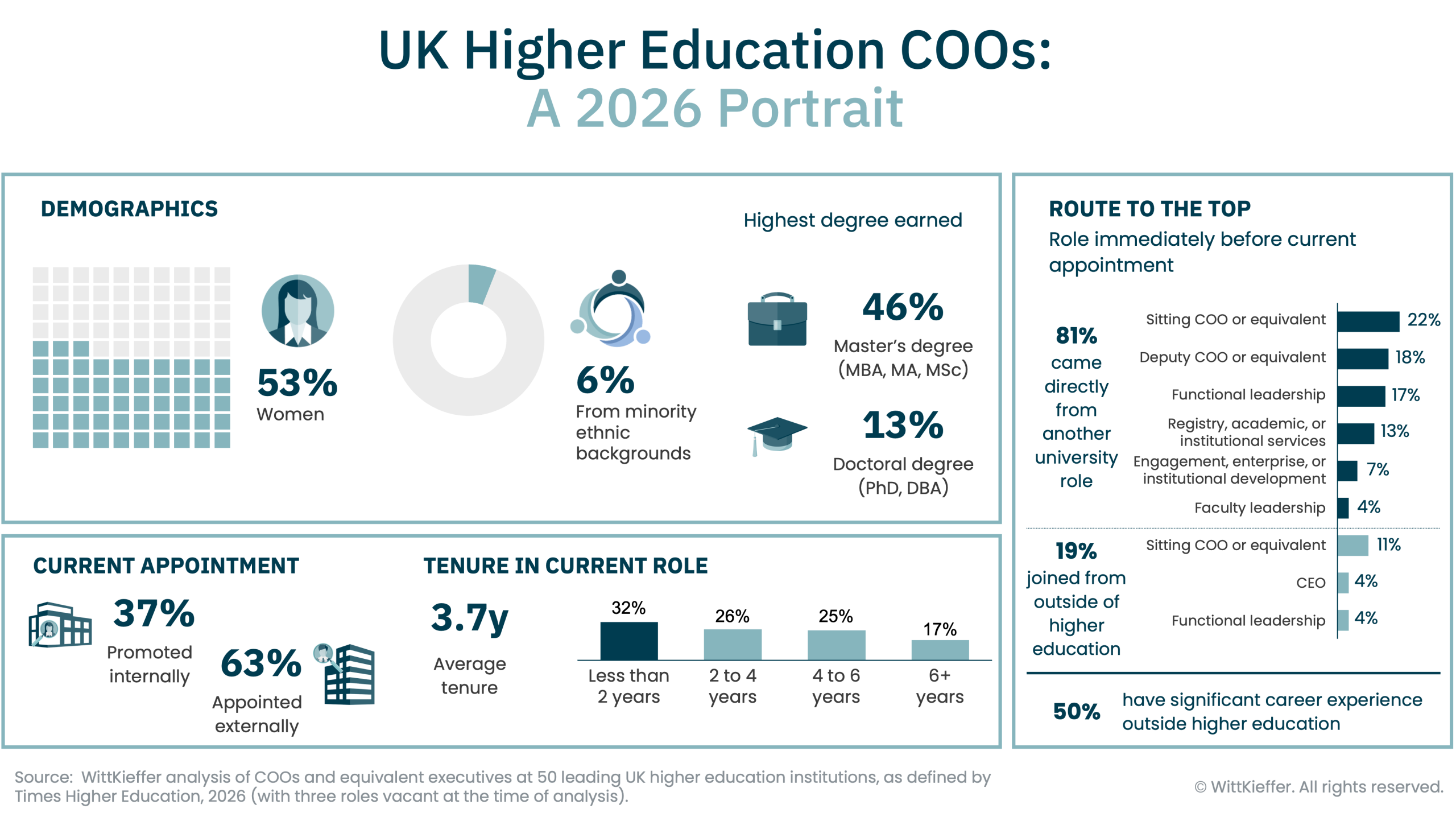
The picture is one of considerable motion alongside relatively cautious appointment patterns, with institutions valuing broader experience but continuing to favour leaders who already understand the university environment.
More than four in five current COOs came directly from another university role, with the largest group having previously served as a COO or deputy COO, followed closely by functional leaders. At the same time, 50% have significant career experience outside higher education, suggesting that institutions value external perspectives when combined with sector understanding. No COO in the cohort moved directly into the role from outside the UK.
These leadership profiles tell us who universities are choosing to lead their operating functions. To understand how those leaders are positioned to succeed, we need to look at the operating model around them.
Beyond Organisational Charts
Alongside our analysis of the 50 institutions, we conducted in-depth interviews with sitting COOs across UK higher education. Together, these perspectives allowed us to examine how operating authority is distributed and how different structures shape the COO mandate.
COO, Registrar, Secretary, Vice-President (Operations), and Deputy Vice-Chancellor titles tell us relatively little about the positioning or authority of a particular leader. Similar titles can conceal very different remits, whilst leaders with different titles may hold broadly comparable responsibility for professional services.
The COO role therefore provides a useful lens through which to understand how an institution operates in practice, including where responsibility sits, how professional services connect, how decisions translate into delivery, and whether someone, or a defined group, holds an institutional view and the authority to resolve conflicts and ensure execution.
More revealing than the title itself is how an institution answers two questions: who holds integrated executive accountability, and where is professional services delivery located?
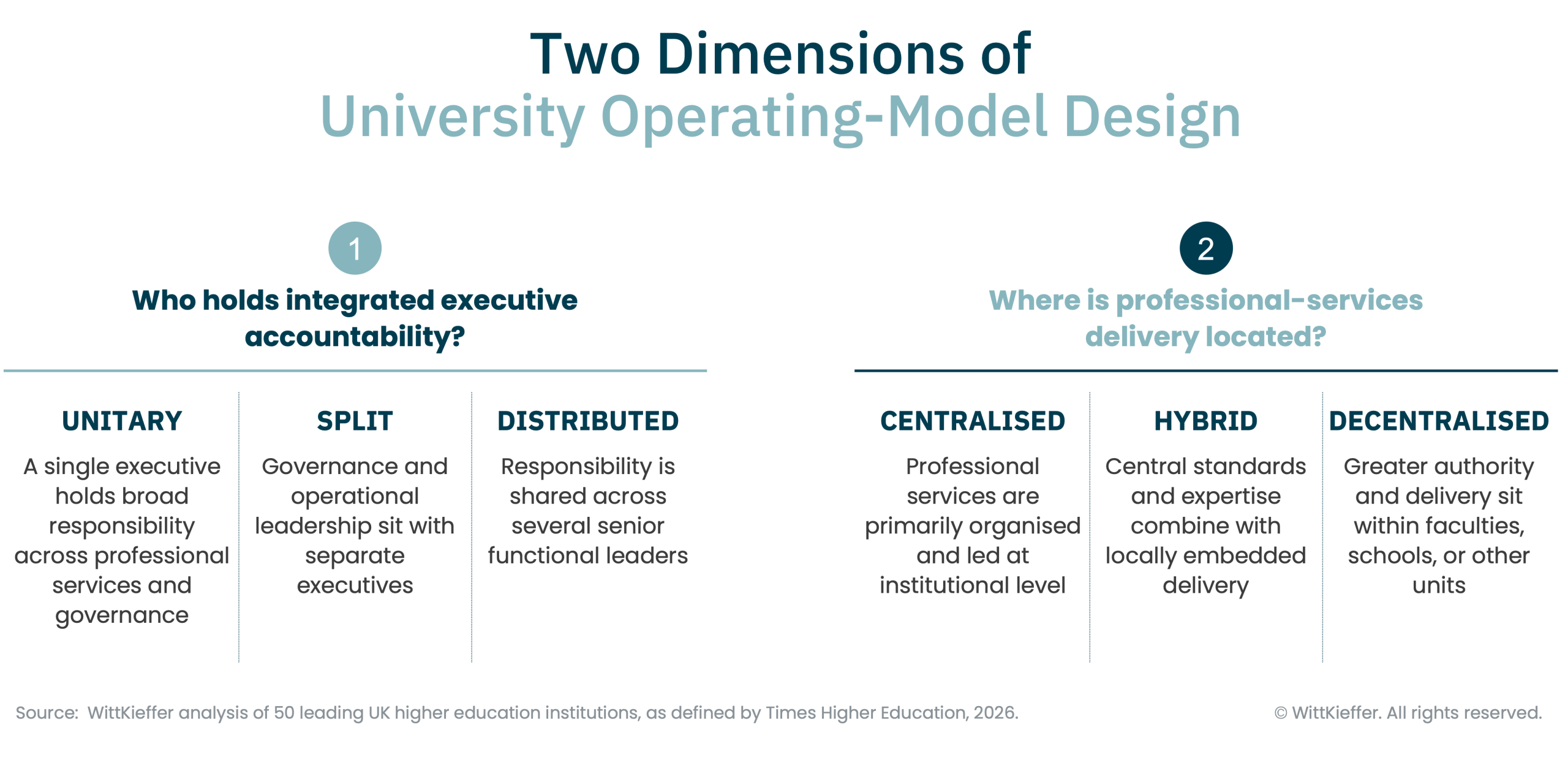
These are separate choices. A university might have a unitary model with decentralised operations, a split executive model with centralised services, or a distributed executive model operating across both central and faculty-based teams.
Across 50 leading UK higher education institutions we analysed, the distributed model was the most common, accounting for 52% of the cohort, compared with 28% operating under a unitary model and 20% under a split model. None of the models are inherently superior. The unitary model provides a fairly straightforward line between governance, authority, and delivery, albeit with a very broad set of responsibilities on the single executive and hence a reliance on good delegation and strong functional leadership. The split model can provide a useful degree of independence between governance and delivery, but requires very strong coordination and decision-making arrangements that will endure beyond the relationship between individual postholders. The distributed model can bring a greater degree of functional depth and expertise into the executive decision-making process, but will require very strong mechanisms for integration, prioritisation, and institutional accountability.
The location of professional services delivery creates a different set of trade-offs. A centralised modelcan reduce duplication, provide greater leverage for transformation, and be more financially sustainable. The downside is that it can potentially erode local autonomy if it is not well designed. A decentralised model can allow for a much more tailored and responsive level of support for the academic units but at the risk of fragmentation, duplication, and inconsistent quality of service. A hybrid model can provide the benefits of central standards and expertise with the ability to deliver in a way that is responsive to the needs of the local unit, as long as the accountabilities are clear.
The question, then, is not which model is best, but whether authority, accountability, and delivery have been consciously aligned with the institution's strategy, culture, and operating needs.
Design Principles That Transcend Structure
Whatever structure an institution chooses, governing bodies and executive teams need to be clear about where institutional coherence sits and how accountability for delivery is exercised.
One interviewee described a key portfolio in which risk had not been sufficiently visible at institutional level. Over successive leadership changes, responsibilities and reporting lines had accumulated without a clear organising logic. This weakened mechanisms for execution, reporting, and accountability. Layers of decision-making made it harder to remove blockers and deliver change, even with capable functional leaders.
The example captures the broader issue: institutions should not create structures that rely on the chemistry or working relationships of the individuals currently occupying them. An effective operating model needs clarity that survives changes in personnel
Whatever structure an institution chooses, six questions matter:
- Accountability. Is it clear who owns institutional delivery?
- Authority. Does the COO have authority proportionate to the outcomes expected?
- Escalation. Are decisions made at the appropriate level rather than accumulating at the top?
- Integration. Can professional services operate effectively across functional and organisational boundaries?
- Resilience. Do decision rights and accountabilities survive changes in individual postholders?
- Capacity. Does the model give the COO space to shape long-term institutional capability?
Across our interviews, COOs repeatedly described roles shaped partly by intentional design and partly by context and reaction. Several pointed to pressure points that can consume a disproportionate share of capacity, including regulatory burden, estate maintenance, grant management, funder relationships, cybersecurity, student recruitment, wellbeing, and staff reductions. One COO mentioned chairing 54 committees, making it impossible to contribute meaningfully to most of them.
Such pressures are unavoidable; allowing them to define the role is not. A COO continually required to absorb institutional pressure has less capacity to create the ownership, systems, and capability needed to address its underlying causes.
Vice-chancellors tell us that they want COOs to be close partners in shaping and delivering institutional priorities. That ambition increasingly encompasses institutional transformation, efficiency, digital capability, and better use of data. Realising that ambition requires more than designing the role well on paper. It requires an operating model that protects the COO's capacity to work at an institutional level.
Implications for COO Selection and Succession
As COO roles become more institution-specific, institutions will need to define their leadership requirements more precisely.
Governing bodies and executive teams need to distinguish between a genuinely bespoke role designed for institutional need and a reactive portfolio assembled from immediate pressures. Before defining the person specification, they need to define the institutional operating challenge the leader is being asked to navigate.
That means asking whether the next COO will be expected to lead transformation, strengthen governance, create greater organisational coherence, reshape or centralise services, improve institutional data and decision-making, or address another institutional priority. Often the answer will involve several of these, but their relative importance should be explicit.
Future COOs will also require capabilities that reflect how university operating models themselves are changing. Our interviews reinforced the importance of leaders who can use data to drive institution-wide decisions, create systems that provide timely information, and understand how digital and AI capabilities may reshape services and the workforce. The leadership requirement is less about technical expertise in individual technologies and more about the judgement to determine where technology can genuinely improve institutional capability and where organisational change must accompany it.
This has implications for the leadership pipeline. Half of the current cohort have no substantial experience outside higher education, and no one in our study moved directly into the role from outside the UK. At the same time, leaders hired from industry can struggle to adapt to the decision-making structures, resource constraints, and cultural particularities of universities.
Institutions therefore arguably have work to do on both sides by broadening the experience of internal talent and creating the conditions in which leaders from a wider range of backgrounds can succeed. External candidates cannot be expected simply to navigate unclear structures through force of personality. Their ability to contribute will depend partly on whether institutional authority, governance, and decision-making are sufficiently clear.
Future COO selection should focus less on the safest-looking profile in a candidate pool and more on alignment between the candidate's experience, the institution's operating challenges, and the capabilities it will need next. The strongest candidates will be those able to integrate into the institution, create coherence across complex portfolios, and lead the operating model that strategy will require.
Conclusion: Making COO Roles Work
The diversity of UK higher education means there is no single model for an effective COO role, nor should there be. What matters is that the role is intentionally designed around the organisation's strategy, with clear accountability, sufficient authority, and the space to operate at an institutional level.
Achieving this requires a series of mutually reinforcing commitments. Governing bodies should define the operating model before beginning the search, establishing where institutional accountability sits and ensuring the structure supports it. Executive teams should protect COO capacity for institution-level delivery by resolving issues at the appropriate level and resisting the temptation to add "just one more" responsibility. Institutions should also develop internal talent while creating the conditions for external leaders to succeed, with clear authority, defined decision rights, and operating models that do not depend on personal relationships to function.
Together, these commitments strengthen the COO role, support strategy execution and succession, and improve the institution's ability to attract leaders with the capabilities it will need next.
Ultimately, universities must create the conditions that let COOs be COOs.