Impactful Leaders Podcast | Academic Medicine Dean Insights: John A. Rock, M.D.
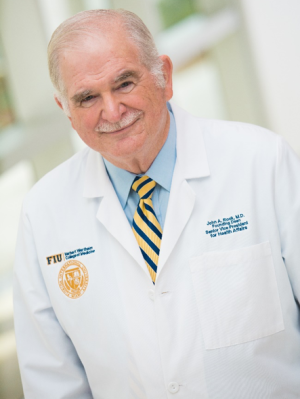 When John A. Rock, M.D., accepted the role of founding dean of the Herbert Wertheim College of Medicine at Florida International University in 2006, he stepped into a role that few have experienced: creating a U.S. allopathic medical school from the ground up. With decades of prior leadership experience at Johns Hopkins University, Emory University, and as chancellor of the Louisiana State University Health Sciences Center, Dr. Rock brought a vision that extended far beyond curriculum design. His goal was clear: “to have a school that really educated wonderful, competent, culturally sensitive physicians who, in the process of their education, would improve the quality of life of the communities that the college was serving.” That commitment to community impact became the foundation for FIU’s signature program, NeighborhoodHELP, which embeds interprofessional teams into households to address social determinants of health. As Dr. Rock explains, “I thought it’d be a wonderful environment for me to really develop a school that’s connected in the community and understands how the College of Medicine would be a very important solution center for them.”
In this Impactful Leaders Podcast, Dr. Rock speaks with WittKieffer’s Valerie Weber, M.D., and Megan Welch on his career and efforts to launch a new medical school. It required more than bold ideas, he recalls—it demanded strategies to ensure innovation would endure. Dr. Rock emphasizes that successful change is never accidental: “Innovation as a leader is very structured and planned. It’s very important that you have the vision and the strategies to make that innovation stick.” From accreditation to team building, his approach centered on inclusivity, collaboration, and creating programs that would not only meet accepted standards but transform medical education for the long term. His leadership philosophy was shaped by experiences rebuilding LSU Health Sciences after Hurricane Katrina, where he saw firsthand the importance of connecting a medical school and academic health system to the communities it serves. That insight informed every decision at FIU, from curriculum design to partnerships with local health systems.
For leaders navigating complex environments in academic medicine, Dr. Rock offers timeless advice: pause before reacting, communicate relentlessly, and build relationships at every level. He underscores that leadership is not a position but a style—one grounded in trust, vision, and adaptability. “Leadership is really a style of delivering an influence, primarily in a change atmosphere… and building teams amongst diverse groups of individuals that inspire.” His career demonstrates that the most impactful leaders combine strategic thinking with a deep sense of social responsibility, ensuring that innovation benefits not only institutions but the communities they serve.
Dr. Rock’s story is a powerful reminder that founding a medical school is as much about shaping culture as it is about building infrastructure. By framing opportunities thoughtfully, engaging stakeholders early, and delivering quick wins that demonstrate commitment, he raised more than $100 million in philanthropic support for FIU Wertheim and created a program that continues to make a measurable difference in thousands of households. His advice resonates for today’s academic medicine leaders: vision without strategy is just an illusion, and true success lies in creating lasting change that others will own, embrace, and carry forward.