Why Field Execution Must Evolve
Field execution — how pharma companies organize, direct, and deliver commercial and medical interactions with healthcare professionals (HCPs), prescribers, and institutional decision-makers (collectively, "customers") — is a major contributor to commercial success. Accordingly, over the past decade, companies have invested heavily in sales force effectiveness, key account management, omnichannel strategies, and data analytics. Yet organizations struggle to translate this investment into consistent impact.
The evidence is compelling. Only 28% of HCPs believe that pharma's customer engagement strategies meet their needs, even though 82% of life sciences executives believe they do (Deloitte, "Unlocking the Future of Customer Engagement in Pharma," 2025). The consequence is not just inefficiency, but customer experiences that feel fragmented and misaligned with the realities of healthcare decision-making. Ultimately, this erodes both market access and commercial performance.
The root cause is divergence in how customers evaluate and adopt therapies. Prescribing and access choices that were once driven primarily by individual physicians are now shaped by clinical pathways, formulary restrictions, institutional priorities, patient outcomes, and real-world evidence requirements. Coverage, frequency, and message consistency remain essential foundations, but they are no longer sufficient on their own.
Organizations must now execute multiple engagement models simultaneously across different account contexts — from individual prescribers to large integrated delivery networks — without fragmenting the customer experience. While portfolio diversity often drives this need, even focused portfolios require tailored approaches depending on account complexity, decision dynamics, and competitive intensity. Commercial leaders must determine where individual field judgment is sufficient and where clearer execution standards, authority, and accountability are required.
Drawing on interviews with senior commercial leaders and our ongoing work in the specialty pharma market, we explore how complexity in decision pathways and cross-functional coordination are reshaping field execution requirements.
Matching Execution to Customer Decision Complexity: Three Execution Models
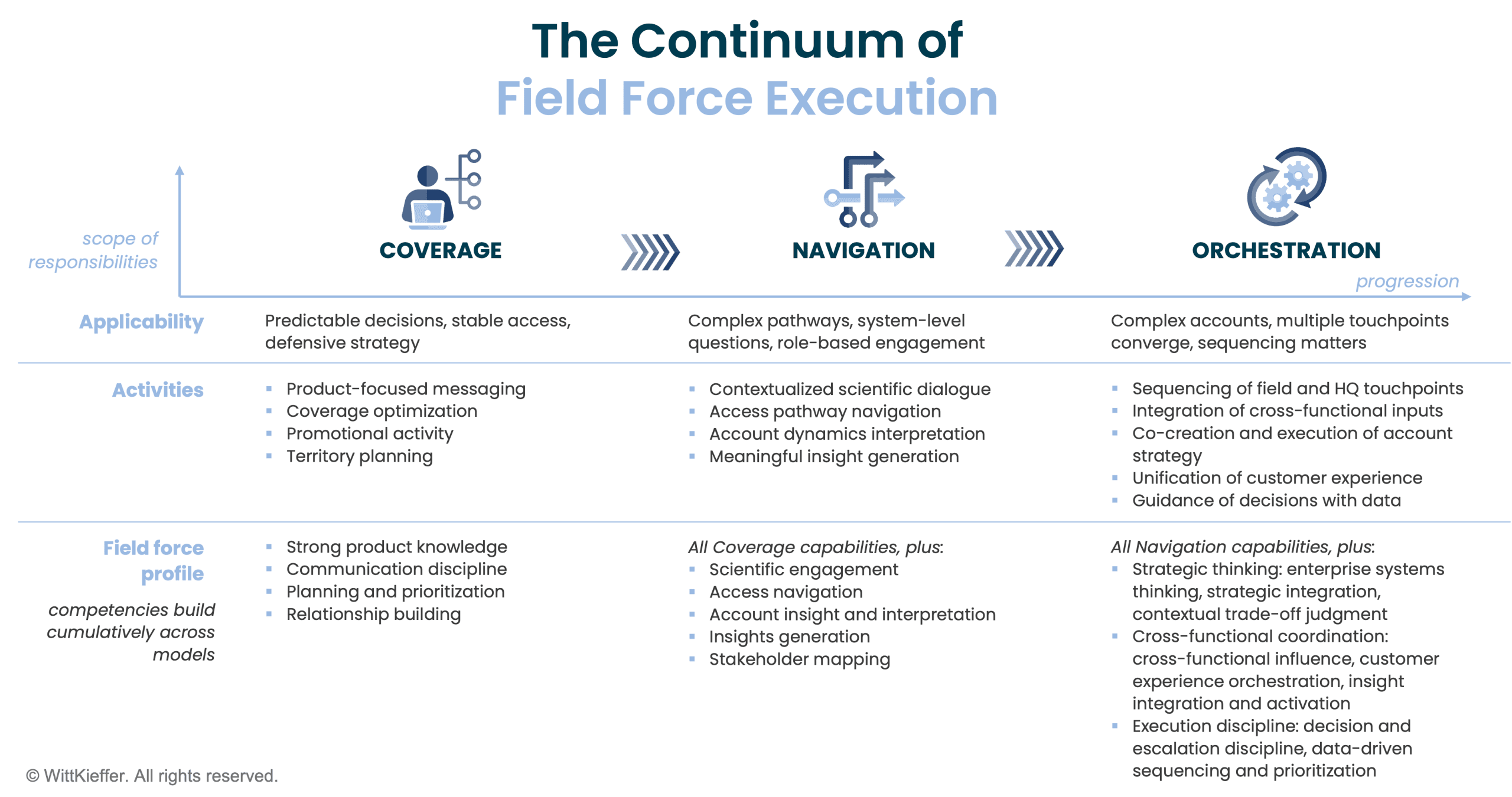
Success depends on matching the field force execution model to the customer decision environment. Organizations generally operate across three distinct models — coverage, navigation, and orchestration — each defined by specific activities and capabilities.
These models represent an evolution along a continuum of execution maturity, i.e., the degree to which commercial leaders make deliberate choices about how these execution approaches are designed, applied, and governed across accounts beyond individual field judgment.
Coverage: Delivering Consistency Through Presence
Coverage, the traditional field execution model, centers on product-focused message delivery, account coverage and frequency optimization, and promotional activity. This model remains effective in settings where prescribing decisions are predictable, access pathways are stable, and the strategic objective is defensive: maintaining share of voice and market position through disciplined presence and consistency. Such settings include biosimilar-dominated segments and mature product portfolios.
The capabilities required, such as strong product knowledge, communication discipline, planning and prioritization, and relationship building, support execution that relies on scale and repetition. Where clinical uncertainty is low and access is straightforward, this approach continues to deliver results.
Navigation: Guiding Decisions in Complex Environments
As decision-making environments grow more complex, the engagement paradigm shifts entirely. Navigation moves beyond frequency of information delivery and market presence to actively guiding customers through complexity by connecting product value to clinical pathways, formulary constraints, and patient populations. Field teams deliver contextualized scientific dialogue, navigate access pathways, interpret account dynamics, and surface meaningful insights that align therapies with local realities.
This requires a distinct capability set: scientific engagement depth, access navigation expertise, account insight and interpretation, insight generation, and stakeholder mapping. Sales representatives, key account managers, and medical science liaisons may all operate as navigators, guiding customers to the information, expertise, and support needed to advance decisions. Navigation also reflects the evolving role of patients in treatment decisions, as navigators help customers evaluate therapies in patient-specific contexts, supporting shared decision-making. Organizations that deploy a navigation field execution model position themselves to compete on insight and guidance rather than presence alone.
Navigation becomes necessary when customers expect guidance on how therapies integrate into clinical pathways, formulary restrictions, institutional budgets, and care coordination requirements — rather than product features alone. It is now the baseline execution standard for advanced biologics in specialty pharma, working effectively when engagement remains primarily role-based and interactions are sequential. It operates at the level of individual interactions. As long as each touchpoint can be optimized independently, this approach preserves flexibility and local responsiveness while elevating engagement quality. That logic begins to strain when engagement must be experienced coherently across multiple roles and touchpoints over time.
"Scientific deep dives are no longer the norm. Engagement now focuses on linking product value to patient outcomes, system efficiencies, and access strategies."
Orchestration: Coordinating Engagement Across Touchpoints
In certain complex accounts — large integrated delivery networks, major hospital systems, academic medical institutions — the challenge shifts from the quality of individual interactions to the cumulative experience of engagement over time. Multiple roles and channels converge around the same decisions. Sequencing begins to matter. Informal coordination is no longer sufficient to prevent fragmentation.
Orchestration is an execution model applied selectively where coordination materially affects outcomes. An orchestrator is empowered to sequence field and HQ touchpoints across channels, integrate cross-functional inputs into account plans, co-create and execute account strategy, unify the customer experience across all touchpoints, and guide decisions with data and analytics. In practice, this function is typically performed by key account managers, national account directors, or individuals in dedicated orchestrator roles, depending on organizational structure and account complexity.
What distinguishes orchestration is authority: the orchestrator decides when and how sales, medical, access, and digital outreach occur within an account. That authority extends to non-personal touchpoints such as congress invitations, medical education, and planned digital communications, so that engagement unfolds as a coordinated experience rather than parallel activities competing for attention.
Critically, orchestration establishes shared expectations and role clarity for how cross-functional teams — commercial, medical, market access, and patient services — engage together in front of customers, reducing the risk that misaligned dialogue undermines account-level objectives.
The aim is not more engagement, but engagement that progresses deliberately and respects the account's decision cadence. Orchestration does not replace navigation; it builds on it by coordinating how high-quality interactions accumulate over time in accounts where sequencing and cross-channel coherence determine whether engagement feels simple or burdensome.
Effective orchestration requires all navigator capabilities plus additional layers: strategic thinking (enterprise systems thinking, strategic integration, contextual trade-off judgment), cross-functional coordination (cross-functional influence, customer experience orchestration, insight integration and activation), and execution discipline (decision and escalation discipline, data-driven sequencing and prioritization).
"In complex accounts, differentiation no longer comes from doing more. It comes from making every interaction feel connected, intentional, and worth the customer's time."
Making It Work: Leadership Implications
Selecting the appropriate execution model is only the first step. How that model is implemented, and whether it can become repeatable and scalable, determines whether it delivers consistently impactful customer experiences or creates new sources of variation.
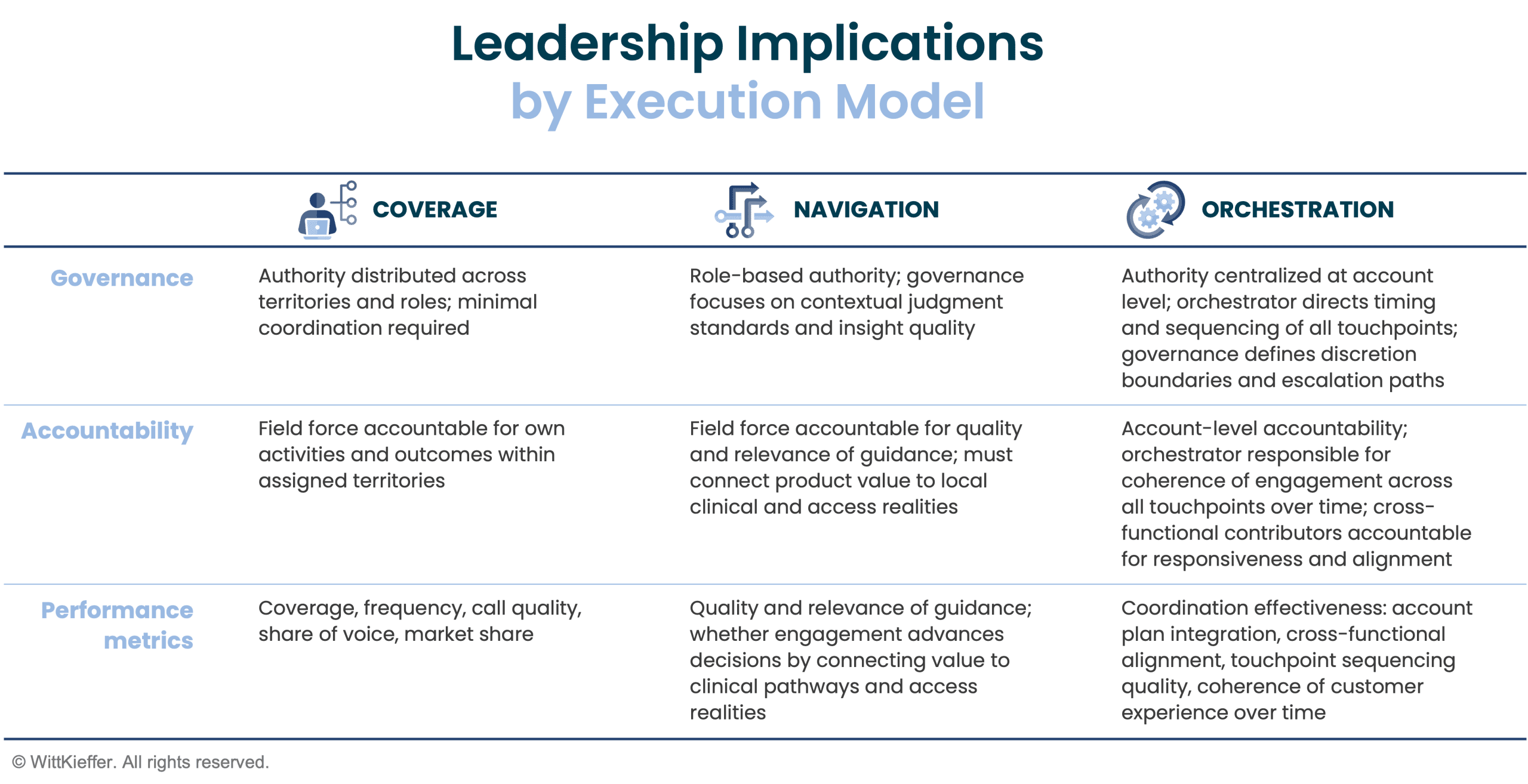
The matrix reveals three critical patterns for leadership choices.
Capability development is non-negotiable. Organizations that progress their field execution models without adequate preparation often underestimate the shift in expectations placed on the field force and overlook the coaching, cross‑functional alignment, and governance needed to embed new ways of working. The result can be execution drift, uneven customer experience, and lower return on investment. For example, organizations that apply orchestration without developing orchestrator capabilities risk creating accountability without enablement. Leaders must decide whether to build capabilities through hiring, development, or role redesign — and how quickly gaps must close.
Governance boundaries determine execution quality. Leaders must define when field teams have discretion to adapt locally and when decision rights are centralized to protect consistency and compliance. The challenge is not choosing between standardization and flexibility, but establishing clear parameters for when adaptation is warranted, such as account complexity, market impact, or patient population characteristics. This approach prevents both over-standardization that misses critical account dynamics and excessive tailoring that fragments the customer experience.
Performance measurement systems must evolve with execution models. When metrics remain anchored to traditional measures (coverage, frequency) while execution models advance to navigation or orchestration, organizations reinforce behaviors that conflict with the engagement they seek to create. Incentives must recognize orchestrated behaviors such as integrating inputs, sequencing touchpoints, and ensuring continuity — not just short-term quantitative outcomes.
The Path Forward
The execution gap — the disconnect between how organizations currently engage customers and what those customers actually need — will not close through incremental tweaks to traditional field models. Closing it requires deliberate choices about where coverage, navigation, and orchestration belong — and then intentionally building the governance, accountability, and performance measurement systems each model needs to work.
Start with diagnosis. Where are complex accounts being served with coverage-level engagement when they need more? Where is orchestration being attempted without the authority structures or capabilities to pull it off? Where does navigation fall short because sequencing and coordination now matter more than individual touchpoint quality? These misalignments are what customers experience as fragmentation.
The organizations that get this right will treat execution model design as a strategic capability, not an operational detail. This is not about abandoning traditional coverage execution or adopting orchestration universally. It is about matching the right model to the right environment, building the capabilities each model requires, and ensuring customers experience engagement that is coherent, intentional, and worthy of their time.